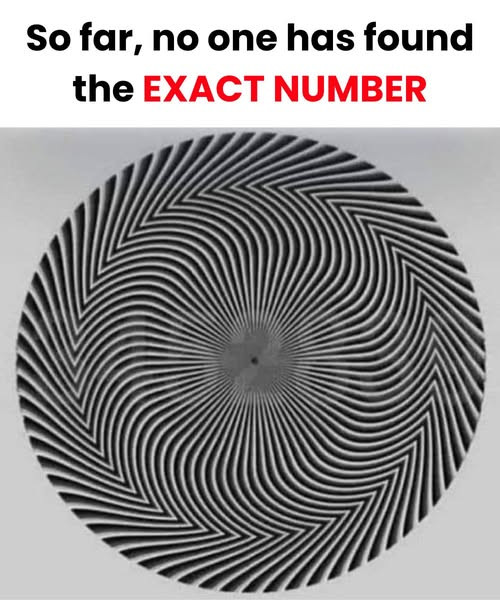
Optical illusions are some of the most intriguing examples of how our brains and eyes can disagree about what’s right in front of us. Among them, one particular image has recently taken the internet by storm: a mesmerizing black-and-white spiral filled with curved lines, captioned with a challenge — “So far, no one has found the exact number.”
The task seems simple enough: look at the image and read the hidden number. But as millions of people quickly discovered, this isn’t just a casual test of observation. It’s a fascinating experiment in how human vision interprets patterns, contrast, and depth. Some people see a number instantly; others see nothing at all. And even among those who spot it, the number they perceive often differs from what others report.
So what’s really happening here? Why do some people see the number clearly while others can’t? And what does this illusion reveal about the mysterious ways our brains decode light and shape?
Let’s dive deep into the science, psychology, and visual trickery behind one of the internet’s most captivating illusions.
The Image That Broke the Internet
At first glance, the illusion looks like a hypnotic spiral made of black and white stripes, twisting inward toward a faint gray center. But hidden within those repetitive lines is a seven-digit number.
The challenge, which circulated widely on social media, read: “So far, no one has found the exact number.” Users stared, squinted, tilted their screens, and even inverted the colors, trying to see what lay beneath.
People reported all kinds of numbers — 3452839, 345289, 3452838, and even nothing at all. The optical confusion became a viral debate, with users defending their answers passionately, each convinced they saw the correct number.
And that’s exactly what makes this illusion so fascinating: it’s not about tricking your eyes—it’s about how your brain processes visual contrast.
The Science of Hidden Numbers: How Contrast Illusions Work
To understand this image, we need to talk about how our eyes and brains collaborate to make sense of visual information.
When you look at any picture, your eyes aren’t really “seeing” solid objects. Instead, they’re detecting differences in light intensity—brightness, contrast, and color transitions. Your brain then takes that flood of information and tries to organize it into recognizable shapes.
This illusion takes advantage of that system by overlaying two visual layers:
- A base pattern of curved black-and-white stripes that stimulate your visual system with high contrast and movement-like energy.
- A hidden grayscale number embedded subtly in the middle frequency range—barely different in brightness from its surroundings.
Here’s where things get clever: your retina and visual cortex process different frequencies of light separately. The black-and-white pattern dominates the high-contrast channels of your vision, drowning out subtler mid-tones where the number is hiding.
Some people’s eyes and brains are more sensitive to those mid-tones, allowing them to “see through” the interference and distinguish the faint number. Others are more responsive to high contrast, making the number effectively invisible.
It’s not a test of eyesight—it’s a test of contrast sensitivity and pattern filtering, abilities that vary from person to person.
The Hidden Number: What Most People See
After countless online discussions, digital analysis, and color inversions, the hidden number within the image was determined to be 3452839.
If you focus on the center of the image for a few seconds, then slowly unfocus your eyes (as though looking “through” the screen), the number begins to appear in soft gray lines. Some people find it easier to spot the digits if they:
- Step back from the screen by about 1–2 meters.
- Squint slightly, reducing high-frequency noise.
- Lower screen brightness to minimize glare.
- Convert the image to grayscale or adjust contrast using an editor.
These tricks help reduce the overpowering interference pattern, allowing the subtle brightness variations of the hidden digits to emerge.
Why People See Different Numbers
Not everyone sees the same number—and that’s perfectly normal. The reason lies in a phenomenon called spatial frequency sensitivity, which describes how well your visual system can detect patterns of different sizes and contrasts.
Your retina has two main types of photoreceptors:
- Cones, which detect fine detail and color.
- Rods, which detect movement and contrast in low light.
Depending on your unique balance of these cells, and the way your brain filters visual information, you may be more or less sensitive to subtle changes in brightness.
In fact, age, screen resolution, lighting, and even eye fatigue can all influence how your brain perceives the number.
So if your friend swears the number is “345289,” and you insist it’s “3452839,” neither of you is exactly wrong—you’re both interpreting a complex pattern differently, filtered through your own biological system.
The Brain Behind the Illusion
Optical illusions like this one work because your brain constantly makes educated guesses about what it’s seeing. It tries to simplify complex images using shortcuts built over millions of years of evolution.
In this illusion, the brain recognizes the strong repetitive lines as background noise, but it also tries to make sense of the faint shapes layered on top. The process involves multiple regions of the brain, including:
- The visual cortex, which detects edges, contrast, and motion.
- The inferior temporal cortex, which identifies shapes and patterns.
- The prefrontal cortex, which interprets what you think you’re seeing based on past experience.
It’s a kind of internal negotiation between what’s physically there and what your brain expects to find. That’s why illusions can fool even the smartest observers—your brain is doing exactly what it’s supposed to do, just in the wrong context.
Why Optical Illusions Are So Addictive
Humans are naturally drawn to puzzles that challenge perception. When you stare at an image like this, your brain experiences a momentary “conflict” between sensory input and interpretation.
That tension triggers curiosity. The more your brain struggles to decode the image, the more dopamine it releases when you finally “see” the hidden number. It’s the same reward circuit that lights up when solving riddles or finishing a crossword.
This is why people spend hours debating illusions online. It’s not just about seeing the number—it’s about the little burst of satisfaction your brain gives you when you finally uncover the secret.
The Role of Technology: How Screens Affect Perception
Here’s a little-known twist: your ability to see the number can also depend on your device.
The image’s contrast pattern interacts differently with various display technologies:
- On OLED screens, which have deeper blacks and sharper contrasts, the interference effect is stronger—making the number harder to see.
- On LCD or LED monitors, the light diffusion softens the pattern slightly, revealing the hidden digits more easily.
- On printed versions, the illusion changes entirely—some people can’t see the number at all, while others see it immediately.
Even the brightness setting on your phone can change your perception dramatically. A simple adjustment from 90% to 60% brightness can bring the number into focus.
A Deeper Lesson: Seeing Isn’t Always Believing
Click page 2 for more