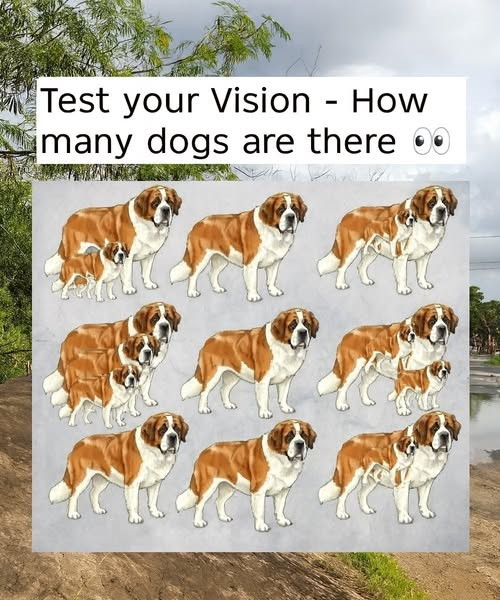
At first glance, this image feels almost boring in its simplicity. A group of Saint Bernard dogs stands calmly against a neutral background. They look friendly, familiar, easy to count. Your eyes move across the picture, your brain performs a quick calculation, and a number appears almost automatically. Nine dogs. Maybe ten. You feel done. The image no longer demands attention.
That moment of confidence is exactly where the illusion succeeds.
This picture is not a test of eyesight. It is a test of perception, attention, and the brain’s deep habit of choosing efficiency over accuracy. What makes it powerful is not trickery or distortion, but subtle design. Every dog shape, every overlap, every repeated curve has been placed with intention. The image does not hide dogs behind blur or camouflage. It hides them inside what you already think you understand.
The correct number is sixteen dogs. The fact that so many people miss nearly half of them is not embarrassing. It is human.
WHY THE BRAIN LOVES TO STOP EARLY
The human brain is a prediction machine. It does not wait to gather all information before deciding what it sees. Instead, it builds a quick hypothesis and sticks to it unless something forces a correction.
The moment your brain identifies the first few dogs, it forms a rule: this image contains a row of similar dogs, evenly spaced, repeating the same shape. Once that rule exists, your perception becomes selective. You see what fits the rule and ignore what complicates it.
This is not laziness. It is efficiency. In real life, this ability keeps us safe. Recognizing patterns quickly helps us navigate traffic, read facial expressions, and respond to danger. But in an illusion like this, that same efficiency becomes the weakness.
The brain believes it already knows the answer, so it stops asking questions.
HOW OVERLAPPING SHAPES TURN ONE DOG INTO TWO
Several of the hidden dogs in this image share body parts with others. One back becomes the chest of another. A leg belongs visually to two different bodies depending on how you trace the outline. Some heads are positioned so close together that the brain merges them into a single figure.
Your visual system prefers clean boundaries. When two shapes overlap, it tends to group them into one object unless forced to separate them. This is called perceptual grouping. The brain would rather see one clear dog than two confusing partial dogs.
The illusion takes advantage of this by ensuring that the hidden dogs never fully announce themselves. They do not shout for attention. They whisper from the edges of what you already accept as real.
WHY COUNTING FEELS EASIER THAN SEEING
Counting objects seems like a logical task, but in reality, most people do not count methodically. They estimate. They glance. They trust the first impression.
True counting would require isolating each individual outline, following it from nose to tail, confirming where it begins and where it ends. That takes time, patience, and a willingness to doubt what seems obvious.
Most people do not do this because the image does not feel threatening or complex enough to justify the effort. The brain asks, “Why would there be more?” and moves on.
Illusions thrive in that gap between confidence and curiosity.
EXPECTATION IS THE INVISIBLE FILTER
Expectation shapes perception more than vision itself. When someone sees the caption “How many dogs are there?”, the brain unconsciously assumes a reasonable answer. Five. Eight. Ten. Sixteen feels excessive, so the mind does not seriously consider it.
This expectation acts like a filter. Anything that supports a lower number is noticed. Anything that challenges it is dismissed as shadow, overlap, or decoration.
Once the number sixteen is revealed, the filter collapses. Suddenly, the hidden dogs feel obvious. This shift demonstrates something unsettling but important: perception is not fixed. It updates instantly when beliefs change.
The dogs were always there. Only your mental model changed.
WHY SOME PEOPLE SPOT MORE DOGS IMMEDIATELY
People who find more dogs quickly are not necessarily smarter or more observant in general. They simply use a different default strategy when looking at images.
Some brains process globally first. They see the whole scene, the general idea, the dominant pattern. Others process locally first. They notice edges, details, and inconsistencies before forming a complete picture.
This illusion rewards the second strategy. It favors those who question symmetry, who trace outlines, who notice when one curve does not quite match another.
Click page 2 to continue