Ambiguous images are not just entertainment. They are exercises in cognitive flexibility. They reveal how quickly the brain commits to an interpretation and how resistant it may be to alternative views.
Noticing that an image can be seen in multiple ways is a powerful mental skill. It encourages humility, curiosity, and openness. It reminds the mind that first impressions are efficient but incomplete.
This awareness extends beyond images. In conversations, conflicts, and life events, the first interpretation is rarely the only one. Training the brain to hold multiple perspectives reduces reactivity and enhances emotional intelligence.
FROM PERCEPTION TO CREATION
The way a person perceives ambiguity influences how they create meaning in the world. In work, art, and daily problem-solving, perception shapes approach.
A grounding style often excels in building systems, maintaining quality, and preserving continuity. An adaptive style excels in innovation, connection, and transformation. Societies need both. Progress depends on the dialogue between stability and change.
Within an individual, cultivating both modes leads to resilience. Knowing when to slow down and when to move forward is a skill developed through self-awareness.
THE DANGER OF OVERSIMPLIFICATION
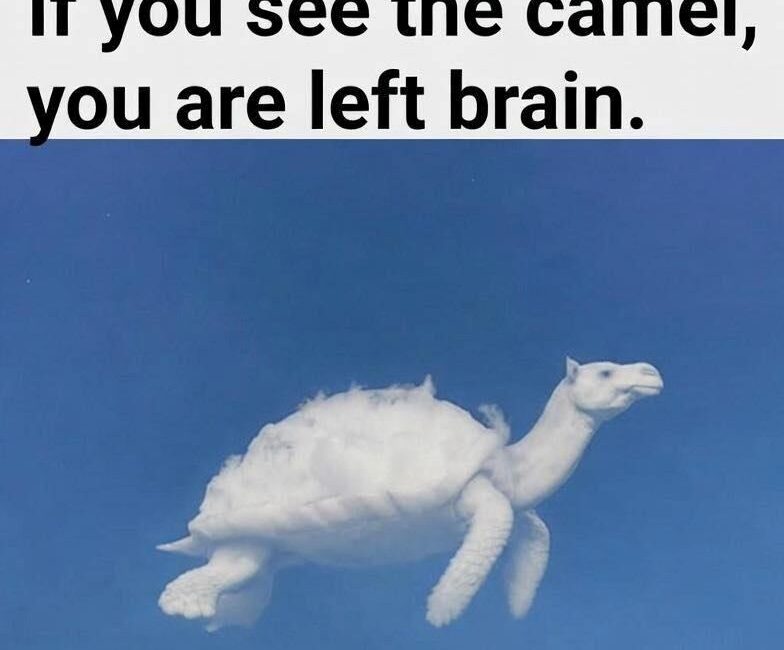
Social media often presents illusions like the turtle and camel as definitive personality tests. This framing is misleading. Human cognition is complex, layered, and dynamic.
Reducing perception to labels can create unnecessary self-limitation. A person may begin to identify too strongly with one category and ignore their full range of abilities.
The true value of such illusions lies in reflection, not classification. They invite curiosity about how the mind works rather than offering final answers.
PERCEPTION, STRESS, AND MODERN LIFE
Modern life places constant demands on attention. Notifications, multitasking, and information overload push the brain toward efficiency. This often means relying on habitual perceptual shortcuts.
Under chronic stress, the brain may default more strongly to one processing style. Some people become hyper-focused on details as a form of control. Others become increasingly big-picture as a way to escape overwhelm.
Recognizing these shifts allows for conscious recalibration. Practices such as mindfulness, physical movement, creative play, and rest help restore balance between modes of perception.
PERCEPTION AS A DAILY PRACTICE
Perception is not a fixed trait. It is a practice shaped by attention. What one chooses to notice repeatedly becomes dominant.
Slowing down to observe details trains the brain toward grounding. Stepping back to see patterns trains the brain toward synthesis. Both can be cultivated intentionally.
This flexibility is especially valuable in uncertain times. The ability to switch between perspectives allows for both stability and innovation.
WHAT THE ILLUSION REALLY OFFERS
The turtle-or-camel image does not reveal secret truths hidden deep in the brain. It reveals something more practical and empowering: the mind’s preference for resolving uncertainty in familiar ways.
This awareness fosters self-compassion. There is no correct way to see the image, just as there is no correct way to think. Each style carries strengths and limitations.
The illusion becomes meaningful not because it categorizes, but because it reminds. It reminds that perception is constructed, that first impressions are efficient guesses, and that reality is richer than any single interpretation.
In a world that rewards certainty, ambiguous images quietly teach tolerance for complexity. They whisper that meaning is flexible, perspective-dependent, and always open to revision.
That lesson, far more than whether one sees a turtle or a camel, is the real secret revealed by the brain.