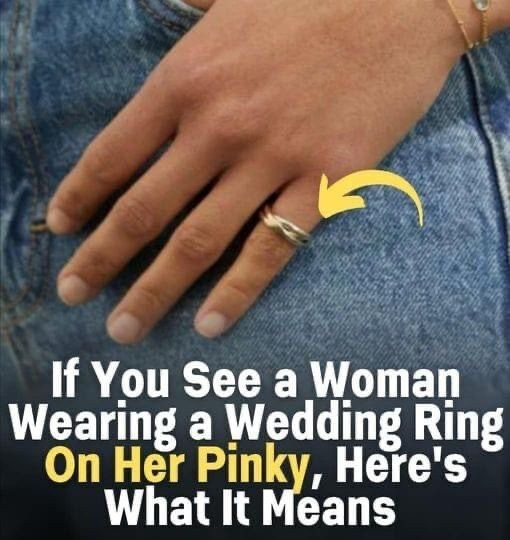
For generations, women’s hands have been read like open books. A quick glance was often enough for society to assign a label, a status, a story. A ring on the left ring finger meant married. A diamond meant engaged. No ring often meant single, available, or waiting. This silent language was so deeply ingrained that it became automatic, almost unconscious. Hands stopped being personal and became public information.
That is why the pinky ring feels so disruptive.
At first, it looks like nothing. A small ring on the smallest finger. Easy to overlook. Easy to dismiss as fashion. And yet, the pinky ring carries a meaning that unsettles old assumptions in the most elegant way possible. It refuses to answer the questions people are used to asking. It does not explain relationship status. It does not confirm availability. It does not belong to tradition.
Instead, it speaks a new language — one centered on self-love, independence, and personal authority.
WHY RINGS HAVE ALWAYS BEEN MORE THAN JEWELRY
Rings are among the oldest forms of symbolic adornment. Long before modern romance, rings represented power, allegiance, contracts, lineage, and control. Kings wore signet rings. Families passed rings through generations. Rings sealed documents and declared ownership.
When romantic rings became dominant, especially engagement and wedding rings, they absorbed all the cultural attention. Over time, the ring finger became a social checkpoint. A woman’s hand stopped being her own story and became a signal to others.
This created a strange imbalance. Men’s rings were optional. Women’s rings were expected, interpreted, and judged.
The pinky ring breaks this pattern by choosing a finger that was never claimed by those expectations.
THE PINKY FINGER: SMALL, IGNORED, AND STRANGELY FREE
The pinky finger has always existed at the edge of function. It does not grip strongly. It does not point. It rarely wears jewelry. Because of this, it escaped heavy symbolism for centuries.
That lack of meaning became its greatest strength.
When a woman chooses the pinky finger, she chooses a space untouched by tradition. No inherited rules. No romantic scripts. No social obligations. The finger becomes a blank page.
This is why the pinky ring does not feel loud or aggressive. It feels intentional. Calm. Self-contained.
THE MODERN SELF-LOVE MOVEMENT AND THE PINKY RING
The modern meaning of the pinky ring as a self-love symbol gained visibility through Fred + Far, a jewelry brand that reframed rings as commitments made inward rather than outward.
Instead of waiting for someone else to place a ring on your hand, the idea was simple but radical: place one there yourself.
Melody Godfred, one of the founders, explained that the pinky finger was chosen precisely because it is overlooked. By placing a ring on it, the wearer creates a physical reminder that she deserves care, attention, and commitment — not someday, not conditionally, but now.
This ring is not about rejecting love from others. It is about refusing to postpone love for oneself.
WHY THIS IDEA RESONATES SO DEEPLY WITH WOMEN TODAY
Modern women are navigating contradictions. They are encouraged to be independent but also accommodating. Ambitious but not intimidating. Loving but self-sacrificing. Strong but soft. The result is often exhaustion and quiet self-erasure.
The pinky ring becomes a small rebellion against that pattern.
It says:
I am not waiting to be chosen.
I am not incomplete without a symbol from someone else.
I am allowed to prioritize myself without apology.
This message is subtle, but subtlety is its power. It does not provoke debate. It does not demand explanation. It simply exists.
A SYMBOL THAT DOES NOT NEED PERMISSION OR VALIDATION
One of the most powerful aspects of the pinky ring is that it does not require a moment sanctioned by others. There is no proposal. No ceremony. No witnesses. No approval.
The decision is private, even though the symbol is visible.
This reverses centuries of tradition where women’s jewelry often marked events decided by others. The pinky ring marks a decision made internally.
That shift — from external validation to internal alignment — is the heart of its meaning.
THE HISTORICAL ROOTS MOST PEOPLE NEVER LEARNED
Although the modern interpretation feels contemporary, the pinky ring has quietly carried meaning before.
In Victorian times, women sometimes wore rings on the left pinky finger to signal that they were unmarried but not actively seeking a partner. It was a coded message, subtle enough to maintain social respectability while asserting independence.
Even then, the pinky served as a quiet communicator of autonomy.
Click page 2 to continue