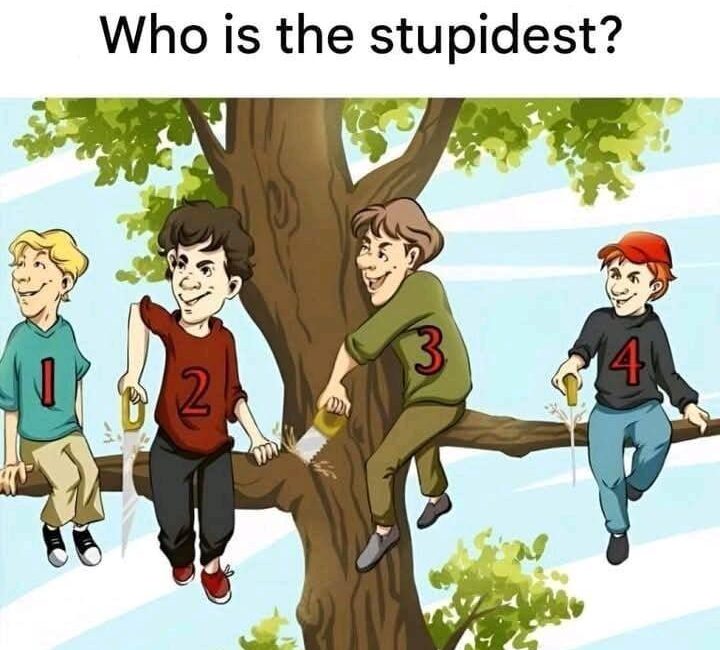
At first glance, this image looks almost childish. Four people sitting on tree branches, each holding a saw, each apparently doing something foolish. The caption asks a blunt question: Who is the stupidest? or, framed more gently but no less provocatively, Who is making the biggest mistake?
Most people answer quickly. Almost instinctively. They point to one number without hesitation and feel confident they are right.
That confidence is exactly what this puzzle is testing.
Because this image is not really about intelligence, stupidity, or even trees. It is about how humans evaluate risk, causality, short-term action, and long-term consequences — and how easily we jump to conclusions based on what looks obvious.
WHY THIS IMAGE GRABS ATTENTION SO FAST
The human brain loves clarity. It loves clean answers, especially when a question appears simple. This image presents four figures, four actions, and one implied failure. It invites comparison. It encourages judgment.
And it does so using a familiar scenario: people doing something that will obviously end badly.
But what makes this puzzle powerful is that not all mistakes are equal, and not all foolish actions are immediately visible as such.
Some errors are loud and dramatic.
Others are subtle, delayed, and more dangerous.
A QUICK DESCRIPTION OF THE SCENE
Four individuals are sitting on different branches of the same tree.
• Person 1 is sitting calmly on a branch, not actively sawing anything.
• Person 2 is sawing the branch between himself and Person 1.
• Person 3 is sawing the branch attached to the trunk — the structural core of the tree.
• Person 4 is sawing the branch he himself is sitting on, near the trunk.
Everyone seems relaxed. No panic. No hesitation. Just action.
And that calmness is unsettling.
THE OBVIOUS ANSWER — AND WHY MOST PEOPLE CHOOSE IT
Most viewers immediately choose Person 4.
Why?
Because Person 4 is very clearly sawing off the branch he is sitting on. The consequence feels immediate and undeniable. As soon as the cut is finished, he will fall.
It feels like textbook stupidity.
Clear cause. Clear effect. Clear failure.
Our brains are wired to prioritize immediate self-harm as the ultimate mistake. Anything that leads directly to instant damage triggers alarm bells.
And yet — this instinctive answer may not actually represent the biggest mistake.
WHY IMMEDIATE CONSEQUENCES AREN’T ALWAYS THE WORST ONES
Person 4’s error is obvious, but it is also contained. He hurts himself, and the damage ends there. The system as a whole remains intact.
In real life, these are the mistakes we spot fastest: impulsive actions with instant feedback.
But history, psychology, and everyday experience all show the same truth:
The most dangerous mistakes are often the ones whose consequences are delayed, distributed, or hidden behind logic that feels reasonable.
This is where the puzzle becomes more interesting.
LOOKING AT PERSON 2: INDIRECT HARM AND SHIFTED RESPONSIBILITY
Person 2 is sawing the branch between himself and Person 1. He is not directly cutting his own support. He is cutting someone else’s.
This introduces a different type of mistake: harm without immediate self-risk.
At first glance, Person 2 may feel safe. He keeps his seat. He avoids personal danger. But his action removes support from another person.
This mirrors a common human error: making decisions that feel safe individually while causing harm collectively.
However, Person 2’s mistake still affects only part of the system. The tree stands. The trunk is untouched.
The structure survives.
PERSON 3: THE QUIETLY CATASTROPHIC ERROR
Now look at Person 3.
He is sawing the branch at the trunk — the very point where the entire system depends on stability.
He is not cutting his own branch.
He is not targeting another individual.
He is undermining the structure itself.
This is the kind of mistake that often goes unnoticed at first.
The branch does not fall immediately. There is no instant punishment. In fact, he may feel clever — efficient even.
But once the cut is complete, everyone falls.
This is not a personal mistake. It is a systemic one.
WHY SYSTEMIC MISTAKES ARE THE MOST DANGEROUS
Systemic mistakes don’t look dramatic in the moment. They often appear rational, controlled, and justified.
Click page 2 to continue