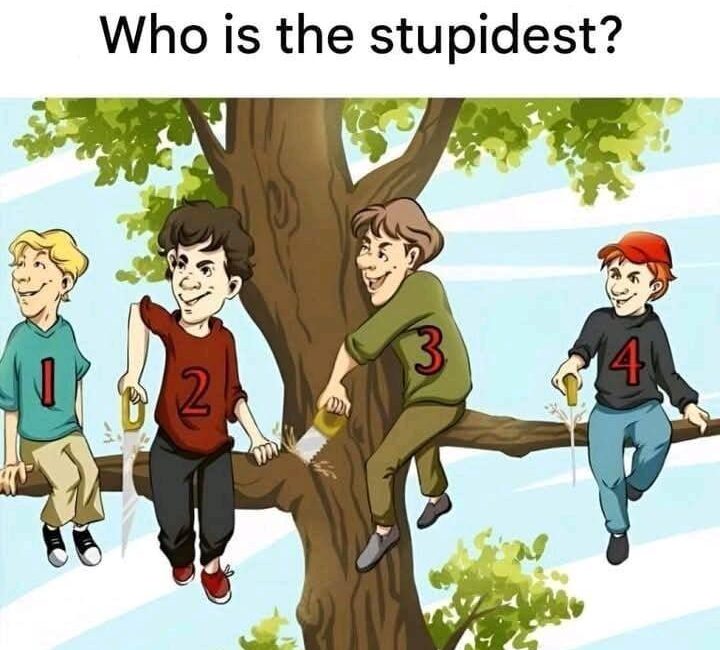
They are the decisions that weaken foundations:
• Cutting safety budgets
• Ignoring maintenance
• Sacrificing long-term stability for short-term gain
• Undermining trust, norms, or infrastructure
By the time consequences appear, it is too late to reverse them.
Person 3 is not foolish in an obvious way. He is dangerous in a quiet one.
WHY THE BRAIN STRUGGLES TO SEE PERSON 3 AS THE WORST OFFENDER
Humans are bad at evaluating delayed consequences. We evolved to respond to immediate threats, not slow collapses.
This is why people often underestimate risks like:
• Structural debt
• Environmental damage
• Relationship erosion
• Burnout
• Long-term health neglect
Person 3’s action does not trigger fear because it does not look immediately stupid.
And that is exactly why it is.
PERSON 1: THE PASSIVE RISK WE OFTEN IGNORE
Person 1 is doing nothing.
At first glance, he seems innocent. But passivity in the presence of danger is also a choice.
He is relying entirely on others not to make catastrophic decisions. He has surrendered agency.
In many real-world situations, inaction in unstable systems is itself a risk.
While Person 1 may not be the biggest mistake-maker, his position reflects a common human tendency: assuming stability without verifying it.
WHAT THIS PUZZLE REALLY TEACHES US
This image is not asking who is stupid. It is asking how you define “mistake.”
• Is a mistake something that hurts immediately?
• Something that hurts only you?
• Something that hurts others?
• Or something that destroys the entire structure quietly?
Most people answer emotionally.
Few answer structurally.
The puzzle reveals whether you think in terms of visible outcomes or hidden systems.
WHY THE “BIGGEST MISTAKE” IS NOT ALWAYS THE MOST OBVIOUS ONE
Person 4’s fall is dramatic but limited.
Person 2’s action is harmful but localized.
Person 3’s decision collapses everything.
If “biggest mistake” means maximum damage, then the answer changes.
The greatest danger is not foolishness that punishes itself — it is competence applied in the wrong direction.
A METAPHOR THAT APPLIES FAR BEYOND THE TREE
This puzzle resonates because it mirrors real life.
People who cut their own branch usually learn quickly.
People who cut others’ branches face resistance.
People who cut the trunk often go unnoticed — until collapse.
Organizations fail this way. Relationships fail this way. Societies fail this way.
The most destructive decisions often come from people who believe they are acting logically, efficiently, or strategically.
THE FINAL INSIGHT
If you answered quickly, you likely chose Person 4.
If you paused, reconsidered, and looked at structure rather than spectacle, you likely chose Person 3.
Neither answer is “wrong” — but they reveal different ways of thinking.
This simple drawing succeeds because it exposes a deep truth:
The biggest mistakes are rarely the loudest ones.
They are the ones that quietly remove what everything else depends on.
And once that foundation is gone, no one stays in the tree.