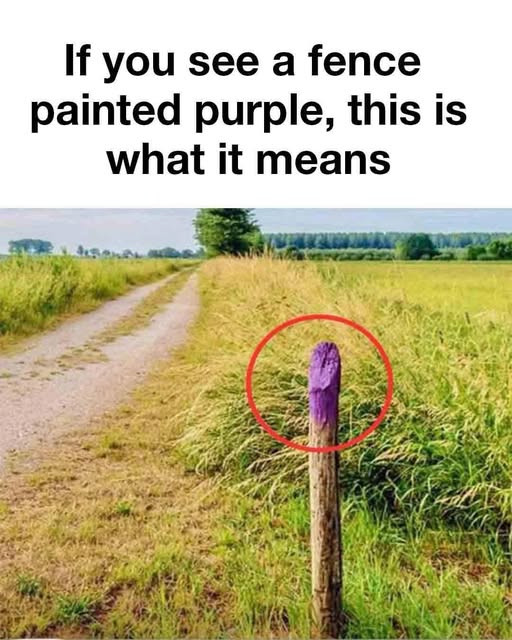
Another misunderstanding is thinking that old or faded paint does not count. As long as the marking is visible and recognizable, age alone does not invalidate it.
Some people assume that if land looks empty, unused, or abandoned, it must be public. Purple paint exists precisely to challenge that assumption.
Private land does not need to look occupied to be protected.
LEGAL AND SAFETY CONSEQUENCES OF IGNORING PURPLE PAINT
Ignoring purple paint can lead to serious consequences. Depending on the state and circumstances, trespassing penalties may include fines, criminal charges, confiscation of equipment, or legal action.
For hunters, the risks are even greater. Trespassing violations can result in loss of licenses, long-term bans, and legal records that follow them for years.
Beyond legal consequences, there are safety concerns. Private land may contain active hunting zones, livestock, heavy machinery, wells, or unstable terrain. Entering without permission puts both the trespasser and the landowner at risk.
Purple paint is not meant to intimidate. It is meant to prevent accidents.
WHY THIS SYSTEM FEELS STRANGE BUT WORKS
Many people feel uneasy about a law that relies on color instead of words. It feels indirect. Too subtle. Too quiet.
But that quietness is exactly what makes it effective. Purple paint does not provoke. It does not escalate. It simply exists.
Once people learn what it means, it becomes one of the clearest boundary markers available. There is no emotional language. No threatening tone. Just a fact.
WHAT TO DO IF YOU SEE A PURPLE PAINTED FENCE OR TREE
If you encounter purple paint, the correct response is simple: do not cross.
If you believe you have a legitimate reason to enter, seek permission first. If you are unsure whether the law applies in that area, err on the side of caution.
For hikers, outdoor photographers, and explorers, this means planning routes carefully and respecting boundaries even when fences are absent.
Purple paint often marks land that does not need a fence to be private.
WHY MOST PEOPLE HAVE NEVER HEARD OF THIS
Despite existing for years, the Purple Paint Law is rarely taught or advertised. It does not appear in driver education. It is not commonly discussed in schools. Many people only learn about it after a negative encounter.
This lack of awareness leads to confusion, frustration, and unnecessary legal trouble.
Understanding the meaning of purple paint is one of those small pieces of knowledge that can prevent big problems.
A QUIET WARNING WITH REAL AUTHORITY
A purple-painted fence does not explain itself. It does not argue. It does not negotiate.
It simply draws a line.
In a world filled with loud warnings and constant noise, purple paint stands as a reminder that the most powerful messages are sometimes the simplest ones.
The next time you see that unmistakable stripe of purple, pause. Recognize it for what it is. Respect the boundary it marks.
Because that single stroke of paint is not just a color.
It is a law.