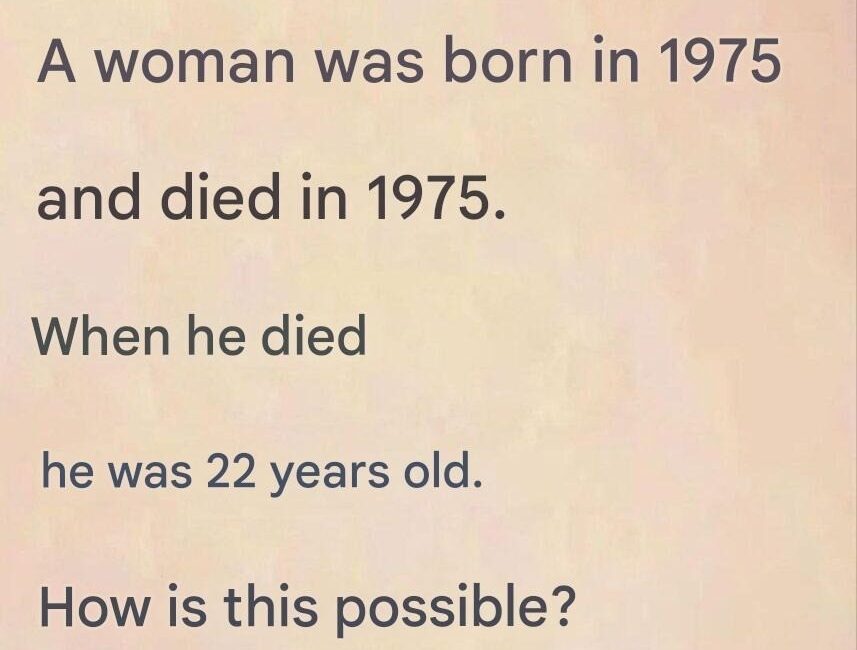
A woman was born in 1975.
She died in 1975.
When she died, she was 22 years old.
At first glance, the statement feels impossible. Time collapses on itself. Years refuse to behave. The mind protests instantly: no human can live twenty-two years inside a single calendar year. The problem seems broken, illogical, or deceptive. And yet, the statement is completely true.
The power of this puzzle lies not in trickery, but in something far more revealing: how the human mind automatically fills in meaning without permission. This riddle is not a test of mathematics or chronology. It is a test of perception, assumption, and the invisible rules our brains impose on language.
To understand how this woman could be born and die in the same “1975” while living twenty-two years, we must dismantle those assumptions carefully and examine how meaning actually forms.
The Sentence That Hijacks the Brain
The riddle is short, clean, and deceptively simple. There are no extra details, no misleading adjectives, no emotional distractions. Yet nearly everyone reaches the same incorrect conclusion immediately: that 1975 refers to a calendar year.
This is not an accident. It is a cognitive reflex.
The moment the brain sees a four-digit number formatted like a year, it locks onto a familiar pattern. Birth years and death years are almost always written this way. We encounter them in biographies, gravestones, news articles, and history books. Over time, the association becomes automatic.
What makes the riddle effective is that it never states that 1975 is a year. That information is silently supplied by the reader. The sentence does not lie. The mind does.
This distinction matters more than it appears.
The Real Answer: 1975 Is Not a Year
The solution is elegantly mundane.
The woman was born in room number 1975 of a hospital.
She died in room number 1975 of another hospital.
Between those two events, 22 years passed.
Nothing in the original statement specifies that 1975 is a year. It is simply a number. A room number, a code, an identifier. The contradiction vanishes the moment the assumption is removed.
What remains is a perfectly ordinary life span described in an extraordinarily misleading way.
Why the Brain Refuses the Correct Answer at First
Even after hearing the solution, many people feel a flicker of resistance. The answer can feel unsatisfying, even disappointing, as though it “cheated.” That reaction is itself revealing.
The discomfort comes from realizing how confidently the brain leapt to an unsupported conclusion. Humans like to believe they reason carefully. Riddles like this expose how much of our understanding is automated.
This puzzle exploits three powerful mental habits:
First, pattern recognition. The brain evolved to recognize patterns quickly because speed once mattered more than accuracy. Seeing “born in” followed by a number triggers a learned shortcut.
Second, contextual compression. The mind fills gaps to save effort. If most similar sentences refer to years, the brain assumes this one does too.
Third, semantic anchoring. Once a meaning is attached to a word or number, it becomes hard to dislodge. Even contradictory information struggles to override the initial interpretation.
The riddle succeeds because it exploits all three simultaneously.
Language as a Trapdoor
Language is not a neutral conveyor of meaning. It is a framework that shapes thought. The same sentence, with the same words, can carry entirely different meanings depending on what the reader unconsciously supplies.
In this riddle, the ambiguity is surgical. The phrase “born in 1975” feels unambiguous because of cultural conditioning, not because of grammar. There is no linguistic rule stating that “in + four digits” must indicate a year. That rule exists only in our expectations.
This reveals an uncomfortable truth: much of what we consider “understanding” is inference, not comprehension.
The riddle works because it exposes how rarely we notice that difference.
The Illusion of Obvious Meaning
One of the most dangerous phrases in human reasoning is “it’s obvious.” Obviousness is often just familiarity wearing confidence as a disguise.
The idea that 1975 must be a year feels obvious because it usually is. But “usually” is not “always.” The riddle forces the reader to confront how often they mistake probability for certainty.
This is the same mental mechanism behind optical illusions. The eye does not see reality; it predicts it. When prediction fails, illusion appears.
Here, the illusion is temporal instead of visual.
Why This Riddle Has Endured for Decades
This puzzle has circulated for generations, long before social media. Its endurance is not due to cleverness alone. It survives because it teaches something fundamental about thinking.
Good riddles do not merely surprise; they recalibrate. After encountering this one, readers become more cautious. They begin to notice how often they assume context instead of verifying it.
The riddle is memorable because the mistake feels personal. You are not tricked by hidden information. You are tricked by your own certainty.
That sting is educational.
A Lesson in Cognitive Bias
Psychologists call this kind of error a cognitive bias—a systematic deviation from rational judgment. Specifically, this riddle highlights assumption bias and framing effects.
The framing of “born” and “died” activates a mental template associated with timelines. Once that frame is active, all incoming information is forced to conform to it.
Click page 2 to continue