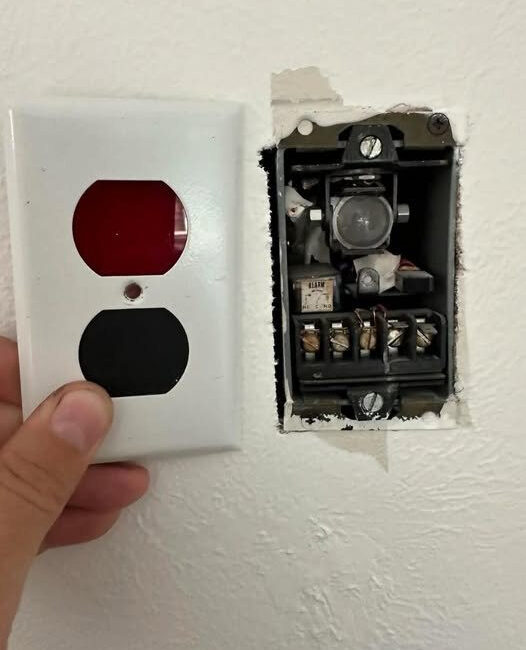
- Run continuously
- Handle low power loads
- Operate inside walls
However, there are important considerations.
It is likely safe if:
- There is no burning smell
- The transformer is not hot to the touch
- Wiring insulation is intact
- The cover plate is installed
- No bare wires are exposed
It deserves attention if:
- You hear constant buzzing or humming
- The wall feels warm
- Insulation looks brittle or crumbling
- The transformer is loose in the box
- You are renovating or opening walls
While the output voltage is low, the input side is still full household voltage. That means it must be treated with respect.
Why You Shouldn’t Touch the Terminals
Even though doorbell systems are low voltage, the transformer itself has two sides:
- Primary side (high voltage, from your house power)
- Secondary side (low voltage, to the doorbell)
Touching the wrong terminal while the system is energized can be dangerous. This is why these devices were meant to be covered and left alone.
Curiosity is fine. Contact is not.
Why This Discovery Makes People Nervous
This kind of find triggers anxiety for very human reasons:
- It’s hidden electrical equipment
- It doesn’t match modern standards
- It looks unfinished
- It lacks obvious labeling
- It feels like a mistake waiting to happen
But what you’re actually seeing is honest old engineering, not a shortcut or hazard by default.
The danger usually comes not from the original installation—but from decades of neglect, modification, or damage.
What Modern Electricians Think When They See This
To an electrician, this discovery is usually unremarkable.
They think:
“Old doorbell transformer.”
“Still common.”
“Easy to replace if needed.”
They’ve seen hundreds of them.
To a homeowner, it feels mysterious. To a professional, it’s just a relic doing its job—or waiting quietly after retirement.
Should You Remove It?
You don’t have to—but you can.
Reasons to keep it:
- Your doorbell still works
- It’s stable and safe
- You want to preserve original systems
Reasons to remove or replace it:
- You’re installing a smart doorbell
- You’re renovating
- You want modern safety standards
- It’s no longer used
Removal is typically simple for an electrician and not expensive.
Why Old Houses Are Full of Discoveries Like This
This won’t be the last surprise.
Older homes often hide:
- Old phone wiring
- Alarm circuits
- Intercom systems
- Antique thermostats
- Abandoned junction boxes
Each one tells a story about how people lived, communicated, and solved problems before modern convenience standardized everything.
The Bigger Lesson
What you found is not a problem—it’s a timeline artifact.
It shows:
- How homes evolved
- How technology layered over time
- How practicality once mattered more than invisibility
Modern homes hide complexity. Older homes expose it—sometimes literally.
Final Thought
That strange “outlet” isn’t a mistake.
It isn’t dangerous by default.
It isn’t a hack job.
It’s a quiet piece of history, still sitting where someone thoughtfully installed it decades ago to make a small bell ring at a front door.
Now that you know what it is, it stops being scary.
It becomes what it always was: a humble transformer, doing—or remembering—its job.