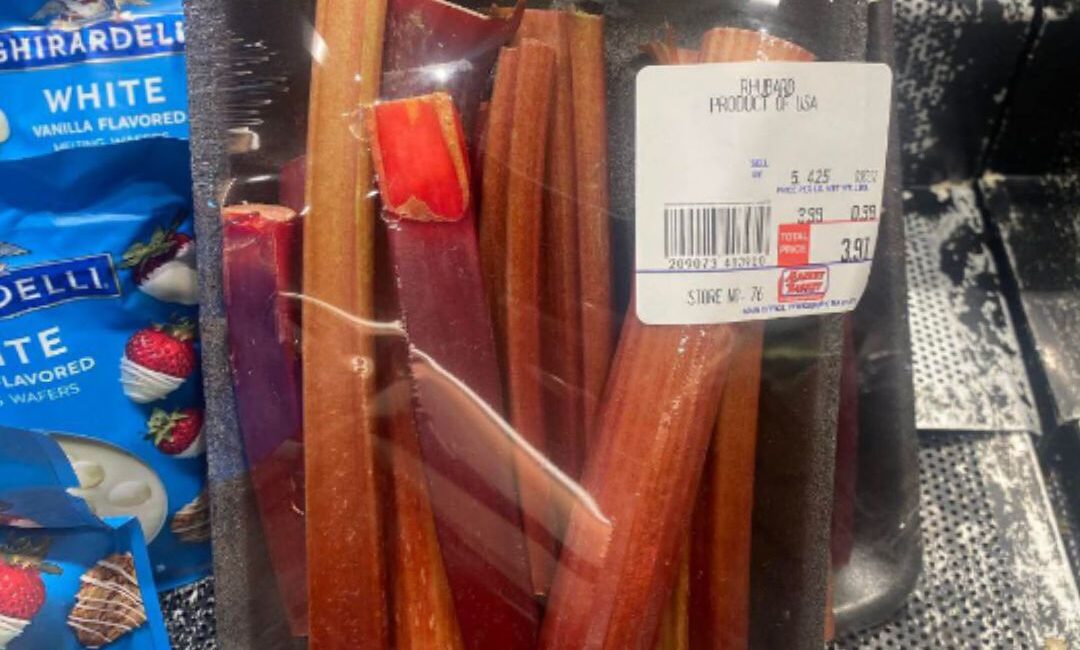
At first glance, it looks confusing. Thick, rigid stalks bundled in plastic. Colors ranging from deep crimson to dusty green. Neither fruit nor vegetable in appearance. Not leafy enough to feel fresh, not familiar enough to feel safe. You spot it in the market and pause, asking the same question thousands of people ask every year:
What is this, and why is it being sold like this?
The answer is rhubarb—a plant with a long, strange, and fascinating history that spans medicine, migration, desserts, toxicity myths, and culinary obsession. Rhubarb is one of those ingredients that looks completely out of place in a modern supermarket, yet has been prized for centuries. It is beloved, feared, misunderstood, and often misused.
This article will take you far beyond “it’s rhubarb” and explain what it really is, why it looks so odd, how it’s used, why part of it is dangerous, why people love it so much, and why it keeps showing up in markets even when most shoppers don’t know what to do with it.
What Rhubarb Actually Is (And Why It Confuses Everyone)
Rhubarb is a perennial plant grown for its stalks, not its leaves, not its roots, and not its flowers. Botanically, it is a vegetable. Culinary-wise, it behaves like a fruit. Culturally, it lives in a category all its own.
The edible part of rhubarb is the stalk, which looks similar to celery but is thicker, tougher, and more fibrous. The stalks can be:
- Deep red
- Pink
- Pale green
- Or a mix of all three
Contrary to popular belief, color does not reliably indicate sweetness. Some green stalks are just as flavorful as red ones. Color depends on variety, growing conditions, and climate.
The leaves, which are large and dramatic, are toxic and always removed before sale. This is why rhubarb often looks “unfinished” in the store.
Why Rhubarb Looks So Out of Place in Modern Markets
Rhubarb is not a grab-and-go food. It doesn’t beg to be eaten raw. It doesn’t advertise sweetness or crunch. It requires intention. That alone makes it feel alien in a world of processed snacks and instant meals.
But historically, rhubarb was not a novelty. It was once considered valuable, even precious.
Before sugar became widely available, rhubarb’s sharp acidity was prized as a flavoring agent. Later, when sugar became cheaper, rhubarb transformed into a dessert staple. That transition cemented its strange identity: technically a vegetable, emotionally a fruit.
A Plant With a Medical Past
Long before rhubarb became a pie filling, it was medicine.
Rhubarb originated in Asia, particularly in regions of China and Siberia, where its roots were used in traditional medicine for thousands of years. It was traded along ancient routes and valued for its digestive and purgative properties.
In medieval Europe, rhubarb root was so valuable it was sometimes worth more than cinnamon or saffron. It was not a dessert plant. It was a treatment.
Only later did people begin using the stalks as food.
Why the Leaves Are Toxic (And Why That Matters)
One of the most persistent facts about rhubarb is also the most misunderstood: the leaves are poisonous.
Rhubarb leaves contain oxalic acid and other compounds that can interfere with calcium metabolism and kidney function when consumed in large quantities. This is why:
- Leaves are never sold
- Leaves are never eaten
- Leaves are discarded immediately after harvest
The stalks, however, contain much lower levels and are completely safe to eat when prepared properly.
This duality—edible stalks, toxic leaves—adds to rhubarb’s reputation as a “dangerous” plant, even though millions of people eat it safely every year.
What Rhubarb Tastes Like (Raw vs Cooked)
Raw rhubarb is intensely sour. Not mildly tart. Not refreshing. Sharp, mouth-puckering, almost shocking.
That sourness is why rhubarb is rarely eaten raw and why people who taste it straight often think something is wrong.
Cooking transforms it.
When heated, rhubarb:
- Softens quickly
- Breaks down into a silky texture
- Releases natural acids that mellow
- Pairs beautifully with sugar, honey, or fruit
The flavor becomes bright, fruity, and complex—somewhere between green apple, lemon, and sour cherry.
Why Rhubarb Is Almost Always Sweetened
Rhubarb is not bitter. It is acidic. That acidity needs balance.
Sugar does not “hide” rhubarb’s flavor—it reveals it. Without sweetness, rhubarb is aggressive. With sweetness, it becomes nuanced.
This is why rhubarb appears most often in:
- Pies
- Crumbles
- Compotes
- Jams
- Sauces
The classic pairing with strawberries exists for a reason: strawberries provide natural sweetness and aroma, while rhubarb provides structure and acidity.
Why People Either Love or Hate Rhubarb
Rhubarb is polarizing because it doesn’t try to please everyone.
People who love rhubarb tend to appreciate:
- Tart flavors
- Complex desserts
- Old-fashioned recipes
- Seasonal ingredients
People who dislike rhubarb often expect sweetness without acidity and are surprised by its sharpness.
This divide is emotional as much as sensory. For many, rhubarb is tied to childhood kitchens, grandparents’ gardens, and traditional cooking. For others, it feels outdated and unfamiliar.
Nutritional Profile: What Rhubarb Actually Offers
Rhubarb is:
- Low in calories
- High in fiber
- Rich in vitamin K
- Contains antioxidants
- Naturally low in sugar
Most of the sugar associated with rhubarb comes from added sweeteners, not the plant itself.
Click page 2 to continue