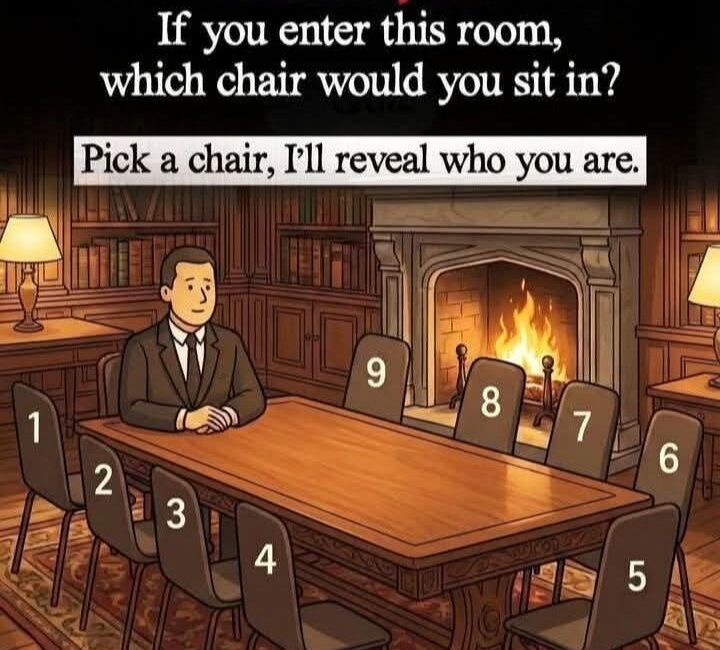
This choice often reflects social intelligence rather than avoidance. Sitting slightly off-center allows for observation, control over attention, and flexibility.
It is the position of people who like options.
Chairs at the Far End (5, 6): Distance, Control, or Protection?
Chairs farthest from the seated man—and closer to the edge of the room—carry a different emotional weight.
Choosing these chairs can reflect:
- A preference for emotional or psychological distance
- Sensitivity to scrutiny
- Desire for autonomy
- Heightened awareness of exits and boundaries
This does not mean fear. In many cases, it signals independence. Some people function best when they are not directly entangled in social dynamics.
Others choose distance because closeness feels overwhelming or intrusive. Again, the same behavior can arise from strength or self-protection.
The Fireplace Factor: Warmth vs Exposure
One subtle detail many people overlook is the fireplace. Chairs near it offer warmth, light, and comfort—but also exposure.
Choosing a seat near the fire may suggest:
- Attraction to comfort and emotional warmth
- Appreciation for atmosphere
- Willingness to sit in visible, illuminated spaces
Avoiding it may suggest:
- Preference for neutrality
- Sensitivity to overstimulation
- Desire for emotional regulation
Your nervous system responds to environmental cues long before conscious thought steps in.
Why These Tests Feel Accurate (Even When They Aren’t Precise)
Psychologically, this kind of test works because of projection.
You don’t just pick a chair. You imagine yourself in the situation. You fill in the silence. You project your own habits, fears, strengths, and experiences into the image.
When you later read an interpretation, your brain highlights what fits and ignores what doesn’t. This is not gullibility—it’s pattern recognition.
The test feels accurate because you participated in creating the meaning.
What This Test Actually Reveals (When Interpreted Honestly)
This image does not reveal your fixed personality. It reveals something more subtle and more useful:
how you tend to position yourself in social spaces under mild pressure.
That positioning is shaped by:
- Past experiences
- Social confidence
- Emotional sensitivity
- Need for control or connection
- Current mental state
And importantly, it can change.
Someone anxious today might choose a distant chair. The same person, feeling safe tomorrow, might choose a closer one.
That flexibility is a sign of health, not inconsistency.
The Hidden Value of These Viral Tests
While they are not diagnostic tools, they serve a purpose.
They make people pause.
They encourage self-reflection.
They reveal habits we rarely question.
Asking “Why did I choose that chair?” is more interesting than the label assigned afterward.
Did you choose comfort?
Visibility?
Distance?
Control?
Warmth?
Safety?
Those answers matter more than any viral caption.
A Final Thought: The Chair Is Not Who You Are
The biggest mistake people make with these tests is taking them literally. You are not a chair choice. You are a complex, adaptive human responding to context.
The real insight comes not from which chair you chose—but from recognizing that your brain made the choice instantly, for reasons that felt obvious only after you noticed them.
That awareness—of your own internal logic—is far more revealing than any personality label.
And that is why these images keep working. Not because they define you, but because they invite you to notice yourself.