A Simple Illusion That Reveals How Easily Our Brains Can Be Tricked
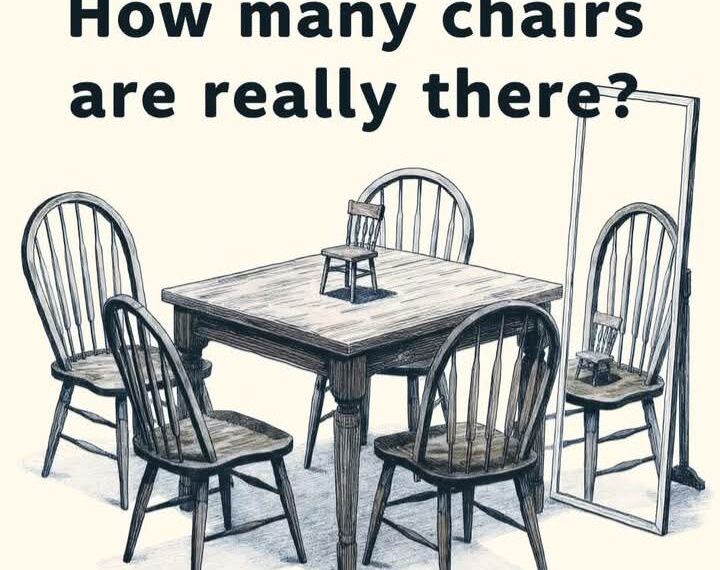
At first glance, the image seems almost ordinary. A wooden table stands at the center of a room, surrounded by chairs. A small chair sits on top of the table. To the right, a tall mirror reflects part of the scene. Above the illustration, a simple question challenges the viewer:
How many chairs are really there?
It looks like an easy counting task. You glance quickly, tally the visible chairs, and settle on an answer with confidence.
But then doubt creeps in.
Did you count the reflected chair?
Does the tiny chair on the table count?
Is the mirror showing something that doesn’t physically exist?
What begins as a straightforward visual count turns into a cognitive puzzle that forces you to question what you’re actually seeing.
This illusion is not just about chairs. It is about perception, assumptions, and the silent shortcuts your brain takes every second.
First Impressions: The Quick Count
Most viewers respond instinctively. They scan the scene and count:
- Four full-sized chairs around the table
- One small chair placed on top of the table
- One chair visible in the mirror
That leads many people to answer: six chairs.
It feels correct. After all, you can see six chairs in the image. Your eyes detect them clearly. Your brain registers six shapes that match the mental category “chair.”
But visual puzzles rarely reward first impressions.
The key word in the question is subtle but important:
How many chairs are really there?
The emphasis is on reality—not visibility.
Counting What Physically Exists
If we step back and analyze the scene logically, we notice that the mirror complicates the count.
Mirrors reflect objects; they do not create them.
The chair visible in the mirror is not an additional physical chair in the room. It is simply the reflection of one already present.
So let’s count only what physically exists in the space.
Looking carefully, we can identify:
- One chair on the left side of the table
- One chair slightly angled in the front left
- One chair on the front right
- One chair behind the table
- One small chair sitting on the table
That totals five physical chairs.
The mirror does not increase the number of chairs in the room. It only duplicates one visually.
So the correct answer is:
There are five chairs.
Why So Many People Say Six
The illusion works because of how the brain processes visual information.
Our perception is fast and efficient. It evolved to interpret scenes quickly, not to analyze them with careful philosophical precision.
When we see a reflection, our brain momentarily treats it as an independent object. Even though we know intellectually that mirrors reflect rather than duplicate, our visual system still registers the reflected image as something tangible.
This creates a subtle mental conflict.
Your eyes say: “There are six chairs.”
Your reasoning says: “Wait, reflections aren’t new objects.”
The puzzle exploits that split-second hesitation.
The Psychology Behind the Illusion
Several psychological principles explain why this puzzle is so effective.
1. Visual Object Recognition
The human brain is highly efficient at categorizing objects. The moment you see something with four legs, a seat, and a backrest, it instantly registers as a “chair.” This process happens almost automatically.
The reflection in the mirror triggers the same recognition pathway. It looks like a chair, so your brain labels it as one.
The brain doesn’t pause to ask whether it physically exists—it simply categorizes what is visible.
2. Reflection Confusion
Although we understand mirrors logically, our perceptual system still processes reflections as real visual stimuli. The reflected chair occupies space in the image, has depth cues, and appears distinct.
This can create what psychologists call perceptual duplication—where the brain temporarily treats a reflection as a separate entity.
In everyday life, this doesn’t cause problems. But in a counting puzzle, it leads to miscalculation.
3. Assumption Bias
When faced with a simple question, most people rely on rapid estimation rather than detailed analysis.
The puzzle is designed to encourage this.
You assume the task is easy.
You assume your first answer is correct.
You assume there is no trick.
The illusion works because of that assumption.
The Small Chair on the Table
Another interesting layer of the puzzle is the tiny chair sitting on the table.
Some viewers overlook it initially because it is out of proportion compared to the larger chairs. Others question whether it should count at all.
Click page 2 to continue