Understanding these distinctions prevents oversimplification.
The Mathematics of Strength: Why Arches Win
The strength of an arch comes from force distribution.
In a straight beam, force creates bending moment — internal stress concentrated at the midpoint.
In an arch, force travels along the curve, converting bending into compression.
Compression is easier for many materials to withstand than tension or bending.
Even a shallow curve introduces this advantage.
This principle is why:
- Bridges arch
- Doorways arch
- Aqueducts arch
And yes — window bars curve.
It is not overengineering.
It is applied geometry.
Manufacturing Practicality: Efficiency Without Cost
Another quiet benefit of curved bars lies in production efficiency.
Bending a metal bar into a uniform arc:
- Requires minimal additional material
- Can be done with standard bending machines
- Does not dramatically increase manufacturing cost
Yet it adds:
- Structural performance
- Durability
- Visual appeal
Few design changes offer that much return for so little cost.
That is why it persists across manufacturers.
When something works mechanically and economically, it survives.
Climate Matters: Coastal and Humid Regions
In coastal areas, salt in the air accelerates corrosion dramatically.
Metal exposed to salt-laden moisture corrodes several times faster than in dry climates.
Window guards in such regions benefit significantly from water-shedding curves.
The faster moisture drains, the less time salt interacts with metal.
Combined with galvanization or powder coating, curved designs can extend functional lifespan considerably.
Design decisions are rarely universal.
They respond to environment.
Subtlety as Engineering Philosophy
The curve is not loud.
It does not advertise itself.
It does not carry branding.
It does not shout innovation.
But it reflects a philosophy:
Small geometric changes can create meaningful performance improvements.
This principle appears everywhere:
- Slight slopes in roads for drainage
- Crowned roofs to prevent pooling
- Tapered chair legs for load distribution
True engineering often hides in modest adjustments.
The curve on window bars belongs to that family.
Psychological Comfort: Security Without Oppression
Security features can create emotional tension.
Heavy bars signal risk. They imply danger.
A curved design softens that signal.
It integrates with decorative motifs.
It reduces the feeling of confinement.
Architecture shapes emotional experience.
Designers who include curves are not only thinking about force distribution.
They are thinking about perception.
Security should protect without reminding occupants constantly of threat.
The curve helps achieve that balance.
Urban Design and Harmonization
In many cities, building codes encourage aesthetic harmony.
Window guards must align with neighborhood character.
Curved elements integrate more seamlessly with:
- Arched windows
- Classical facades
- Mediterranean tilework
- Decorative balconies
Straight industrial bars can clash visually.
Curved bars bridge function and form.
Urban design benefits from subtle continuity.
Longevity Through Geometry
When we think about durability, we often think about thicker materials.
But geometry can be as powerful as mass.
A thicker straight bar may resist bending.
But a thinner curved bar can achieve comparable rigidity through shape alone.
This is efficient engineering.
Use form to enhance material.
Save weight. Save cost. Improve performance.
That is intelligent design.
The Broader Lesson: Why Small Details Matter
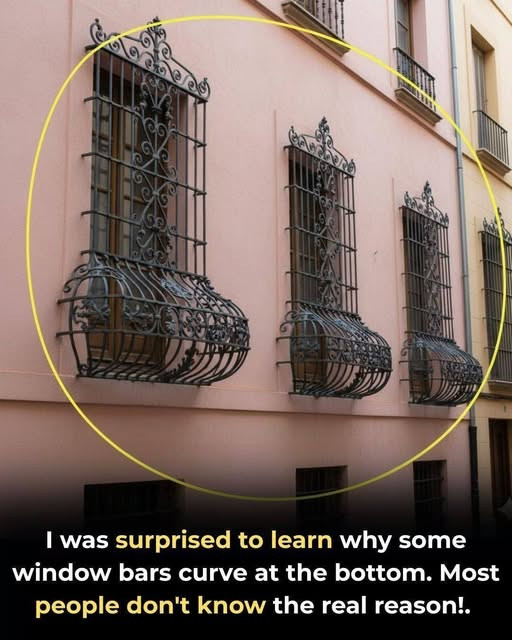
The curved bottom of a window bar is not dramatic.
It does not demand attention.
Most people never consciously notice it.
Yet it improves:
- Structural resistance
- Water runoff
- Corrosion prevention
- Maintenance reduction
- Visual integration
Five benefits from one subtle adjustment.
That is elegant engineering.
We often assume innovation must be complex.
Sometimes it is simply a curve.
Looking Again With Informed Eyes
The next time you walk past a building, pause.
Observe the window guards.
Look at the lower horizontal member.
Notice whether it dips slightly at the center.
That arc represents:
Physics applied quietly.
Material science in motion.
Historical wisdom preserved.
Modern manufacturing practicality.
It protects without announcing itself.
It strengthens without thickening.
It lasts without demanding attention.
Final Reflection: The Power of Thoughtful Design
Great design does not always shout.
Sometimes, it whispers.
The gentle curve at the bottom of window bars is not decoration alone.
It is structural reinforcement.
It is corrosion control.
It is maintenance reduction.
It is aesthetic softening.
It is psychological moderation.
It is engineering done with restraint.
And that kind of design does more than protect glass.
It protects time.
It protects investment.
It protects safety.
It protects peace of mind.
A simple arc of steel — shaped with intention — reminds us that strength is not only about thickness.
Sometimes, strength is about shape.
And sometimes, the smartest innovation is a curve you almost didn’t notice.