The Science Behind the Shocking Discovery — And What It Really Means for Your Food
You bring home a fresh box of strawberries. They look perfect — bright red, glossy, fragrant. Maybe they’re from a farmers’ market. Maybe from your garden. Maybe organic. Maybe supermarket-bought.
You place them in a bowl of salt water, something you saw online — a trick meant to “clean” them thoroughly.
And then it happens.
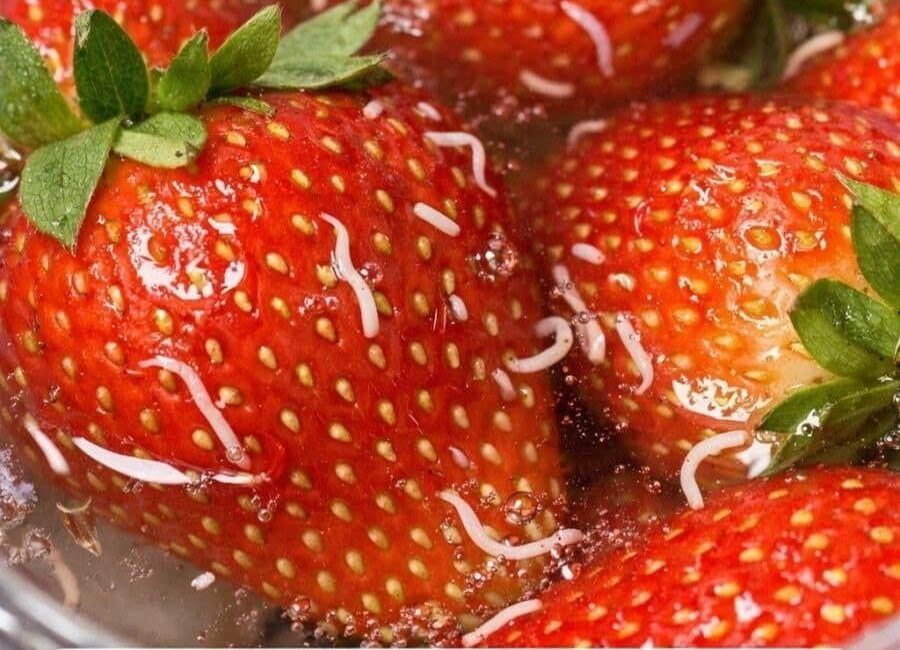
Tiny white, thread-like worms begin wriggling out of the fruit.
Your stomach drops. Your appetite disappears. You question everything.
Before you panic — or throw away the entire batch — let’s slow down and understand what is actually happening.
Because this phenomenon is real. It’s biological. It’s surprisingly common. And it reveals something fascinating about how strawberries grow in the real world.
This is not about contamination.
It’s about ecology.
The Shock Factor: Why This Feels So Disturbing
Human beings are deeply wired to react strongly to worms and larvae.
From an evolutionary perspective, visible parasites often signaled spoiled food or disease risk. So our brains developed a rapid disgust response to protect us.
Seeing movement where we expect purity — especially in something sweet and beautiful like a strawberry — triggers that ancient alarm system.
But the emotional reaction and the scientific reality are not always the same.
The tiny white “worms” that appear are usually larvae — the immature stage of a fruit fly species called the Spotted Wing Drosophila.
Let’s meet the culprit.
Meet the Spotted Wing Drosophila
The insect most commonly responsible is Drosophila suzukii, known as the Spotted Wing Drosophila (SWD).
Unlike common fruit flies that swarm over overripe bananas in your kitchen, SWD is different in one crucial way:
It does not wait for fruit to rot.
It lays eggs in fresh, ripening fruit.
This distinction changes everything.
What Makes This Fruit Fly Different?
Most fruit flies lay eggs on damaged or fermenting fruit. Their larvae feed on decomposing material.
Spotted Wing Drosophila has a specialized, serrated egg-laying organ called an ovipositor.
This ovipositor acts like a microscopic saw.
It allows the female fly to:
- Pierce intact fruit skin
- Deposit eggs inside fresh fruit
- Protect larvae during early development
Strawberries, raspberries, blackberries, cherries — all soft-skinned fruits are vulnerable.
Strawberries are particularly susceptible because:
- Their skin is thin
- Their flesh is porous
- They ripen outdoors
- They contain natural sugars that attract insects
The fruit looks flawless.
Inside, microscopic eggs may already be present.
The Lifecycle Inside the Strawberry
Let’s walk through the biological timeline.
- The female fly pierces the strawberry.
- She deposits tiny eggs inside.
- Eggs hatch within 1–3 days.
- Larvae feed inside the fruit.
- After several days, they mature and eventually pupate.
The larvae are:
- Small (1–3 millimeters long)
- White or translucent
- Soft-bodied
- Legless
- Thread-like
Because they are inside the fruit, you usually don’t see them.
Until you soak the strawberries in salt water.
Why Salt Water Makes Them Come Out
Salt water does not create the worms.
It exposes them.
Here’s what happens scientifically:
When strawberries are soaked in salt water:
- The salt increases the salinity of the surrounding environment.
- The osmotic balance changes.
- The larvae experience stress due to altered water pressure around their bodies.
- They instinctively wriggle outward to escape the hostile environment.
This is an osmotic reaction.
Osmosis is the movement of water across membranes from areas of low solute concentration to high solute concentration.
Larvae are sensitive to salt concentration changes. When submerged in salt water, the environment becomes inhospitable.
Their escape response reveals their presence.
Without salt water, you likely would never know.
Is This Common?
Yes.
Especially in:
- Homegrown strawberries
- Organic farms
- Farmers’ markets
- Regions with warm climates
Organic or low-pesticide produce is more susceptible because chemical controls are limited.
However, even conventionally grown strawberries can occasionally contain larvae.
The presence of larvae does not necessarily mean poor farming practices.
It often means minimal chemical intervention.
Nature was allowed to interact with the fruit.
Are They Harmful?
This is the question everyone really wants answered.
From a medical perspective:
These larvae are not known to cause harm if accidentally consumed.
Humans may unknowingly ingest insect fragments or larvae regularly. Regulatory agencies in many countries even define acceptable levels of insect fragments in processed foods — because completely eliminating them is biologically impossible.
The human digestive system handles small insect larvae without difficulty.
They do not infect the body.
They do not survive stomach acid.
They do not reproduce inside you.
The reaction is psychological, not pathological.
However, that does not make the experience pleasant.
And food preferences are not only about safety — they are about comfort.
Why Strawberries Are So Vulnerable
Strawberries grow close to the ground.
They are:
- Exposed to insects
- Moist
- Soft
- Sugar-rich
- Thin-skinned
Unlike apples or citrus fruits, they do not have thick protective peels.
The tiny seeds (achenes) on their surface create micro-crevices where insects can interact more easily.
Additionally, strawberries do not continue ripening after harvest. They must be picked when already ripe — and that means sweet.
Sweet fruit attracts insects.
This is ecology in action.
Organic vs Conventional: Does It Matter?
Organic strawberries are more likely to contain larvae because:
- Synthetic insecticides are restricted
- Integrated pest management relies on biological controls
- Complete insect elimination is not the goal
Conventional farms may use insecticides that reduce infestation rates.
However:
- No farming method guarantees zero larvae.
- Even treated fruit can occasionally harbor eggs.
The presence of larvae does not automatically mean neglect.
It reflects agricultural trade-offs.
The Role of Climate
Spotted Wing Drosophila thrives in:
- Warm climates
- Moderate humidity
- Fruit-growing regions
Infestations are more common in:
- Late harvest seasons
- Warmer months
- Outdoor farms
Cold temperatures slow larval development.
This is why refrigeration is important.
How to Reduce the Risk at Home
If you want peace of mind, here are evidence-based steps:
- Rinse thoroughly under running water.
- Soak in salt water (1 teaspoon salt per cup of water) for 5–10 minutes.
- Rinse again in clean water.
- Pat dry gently.
- Refrigerate promptly.
Cold storage slows egg development and larval growth.
Inspect strawberries for:
- Overly soft spots
- Bruising
- Puncture marks
- Leakage
Damaged fruit is more likely to contain larvae.
Why Social Media Amplified This Phenomenon
Click page 2 to continue