You probably sat down today without thinking about it.
On a chair at breakfast.
On a sofa scrolling your phone.
At a desk while working.
In a car.
In a waiting room.
And yet, in each of those moments, your body chose a position.
Not randomly. Not mechanically. Your brain and nervous system selected a posture based on comfort, habit, mood, context, and subtle psychological cues. We like to believe that personality lives in words — in what we say, how we dress, how we introduce ourselves. But long before language enters the scene, the body is already speaking.
Sitting posture, especially the position of the legs, is one of the quietest and most overlooked forms of body language. And body language, when interpreted carefully and responsibly, can offer fascinating clues about emotional regulation, confidence, privacy, openness, anxiety levels, and even problem-solving styles.
However, we must begin with an important foundation: no single posture “defines” a person. Human behavior is fluid. Context matters. Culture matters. Physical comfort matters. Injury matters. Personality is complex and cannot be reduced to a single leg position.
What posture can reveal is tendencies — patterns in how someone regulates space, vulnerability, and control.
So let’s explore what different sitting leg positions may signal beneath the surface, not as rigid personality labels, but as windows into how people relate to the world.
Body Language and the Nervous System: Why Posture Is Never Random
Before we examine specific positions, we need to understand something fundamental: posture is governed by your nervous system.
Your brain constantly scans the environment for safety. This process happens below conscious awareness. Psychologists call this neuroception — the subconscious evaluation of whether a situation feels safe, neutral, or threatening.
When you sit down, your body unconsciously asks:
- Is this environment safe?
- Do I need to protect myself?
- Am I being evaluated?
- Am I relaxed?
- Do I need to appear confident?
Your leg position becomes part of that answer.
Legs are large, powerful structures. They are involved in movement and escape. When you cross them tightly, fold them inward, stretch them outward, or plant them firmly, you are adjusting how much of yourself you expose and how ready you are to move.
Posture is regulation in action.
Now let’s explore specific positions.
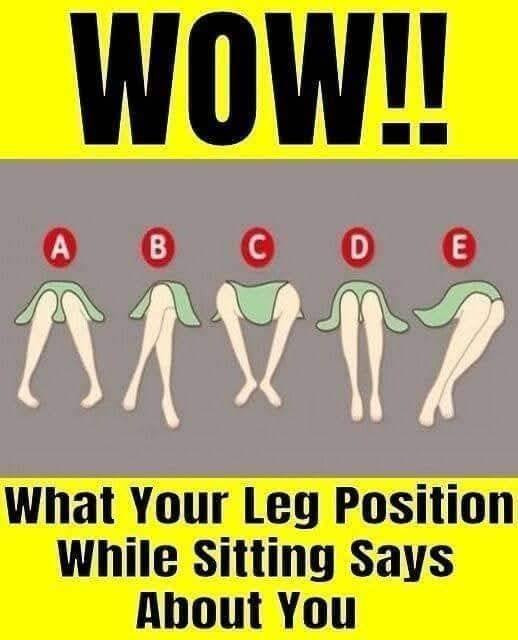
The “A” Position: Legs Extended or Angled Forward
The so-called “A” position typically involves sitting with legs extended slightly forward, sometimes loosely crossed at the ankles, sometimes relaxed and angled outward.
This posture often signals psychological avoidance or emotional distancing — but not in a malicious way.
People who favor this position may:
- Prefer to avoid direct confrontation
- Distract themselves from problems
- Delay decision-making
- Shift responsibility when overwhelmed
This does not mean they are dishonest or weak. It often reflects a coping style built around preserving emotional comfort.
Avoidance is not laziness. It is a strategy the nervous system uses to reduce stress.
Interestingly, individuals who sit this way are frequently described as imaginative, playful, and socially magnetic. Why? Because avoidance can coexist with creativity.
Creative minds often wander. They daydream. They imagine possibilities instead of confronting immediate realities. This can produce charm, humor, spontaneity — and sometimes impulsive speech.
These individuals may talk freely, sometimes before thinking fully. Their minds move quickly, and their emotional filter may lag behind.
The risk? Missed opportunities. Unresolved issues. Problems that grow quietly while attention shifts elsewhere.
The strength? Adaptability. Creativity. Social warmth.
Avoidance is not always weakness. But when chronic, it can limit growth.
The “B” Position: One Leg Crossed Over the Other
Click page 2 to continue