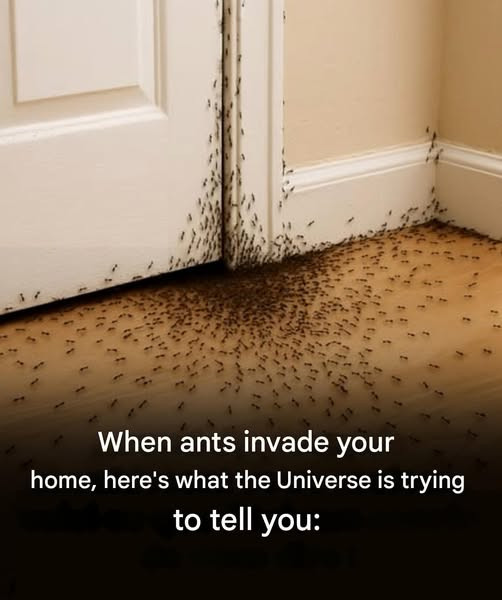
Few household experiences provoke such immediate attention as the sudden appearance of ants marching across a kitchen counter, gathering near a window, or forming an organized trail along a wall. One moment the house feels calm and orderly; the next moment a silent army of tiny insects appears, moving with astonishing coordination. Their presence can feel mysterious, frustrating, and sometimes strangely symbolic.
Across many cultures and traditions, insects entering a home have long been interpreted as more than a simple biological event. Some people see them as signs of seasonal change, others as indicators of hidden environmental issues, and still others interpret them through spiritual or symbolic lenses. Among these creatures, ants hold a particularly fascinating place in human imagination. They are known for their discipline, cooperation, persistence, and ability to build complex societies despite their small size.
When ants suddenly appear inside a home, it is natural to wonder why. Is it simply a search for food? A seasonal migration? Or could their arrival carry deeper lessons about our environment and habits?
Understanding the phenomenon requires examining several layers of meaning. At the most practical level, ants enter homes for survival reasons: food, water, and shelter. At the symbolic level, however, their behavior has inspired countless interpretations about work, patience, order, and resilience.
This article explores both perspectives—the scientific explanations behind ant invasions and the cultural or symbolic meanings people often associate with them. By understanding both sides, we gain a fuller picture of what these tiny visitors might represent.
Sometimes the smallest creatures offer the most intriguing insights into the hidden systems of nature and the subtle patterns of everyday life.
The Remarkable World of Ants
Before interpreting their presence, it helps to understand what ants actually are and why they behave the way they do.
Ants belong to the insect family Formicidae, and they are among the most successful organisms on Earth. Scientists estimate that there are more than 20 quadrillion ants living on the planet. To put this in perspective, that means ants may collectively weigh as much as all humans combined.
Their success comes from their extraordinary social organization. Ants live in colonies structured around cooperation and specialization. Within a colony, different ants perform different roles:
- Worker ants search for food and maintain the nest.
- Soldier ants protect the colony.
- Queen ants reproduce and ensure the colony’s survival.
Despite their tiny brains, ants demonstrate remarkable collective intelligence. Individually, an ant follows simple rules. But together, thousands of ants create complex systems for communication, construction, and resource management.
One of the most fascinating aspects of ant behavior is how they find food. When a worker ant discovers a food source, it releases chemical signals called pheromones on its way back to the nest. These pheromones act like invisible trails that guide other ants to the same location.
This is why ants often appear in long, organized lines inside homes. Once one ant discovers a food source—such as sugar, crumbs, or fruit—others quickly follow the chemical path.
From the ants’ perspective, your home is simply another part of the environment where resources might exist.
Why Ants Enter Homes
From a scientific standpoint, ants enter homes for three main reasons: food, water, and shelter.
Food
Ants are opportunistic feeders. They are attracted to many types of food, particularly sweet substances like sugar, honey, and fruit. Even tiny crumbs left on a countertop can attract them.
Interestingly, ants are not limited to sweets. Some species prefer protein, which means they may also gather around meat, pet food, or grease.
Water
Like all living creatures, ants require water. In dry climates or during hot weather, they often search for moisture sources indoors. Kitchens, bathrooms, and sinks can therefore attract them.
Shelter
Weather changes frequently drive ants indoors. Heavy rain, extreme heat, or cold temperatures may encourage colonies to seek safer environments.
Homes offer warmth, protection from predators, and potential food sources, making them attractive temporary shelters.
In many cases, ants that appear inside are not actually nesting in the house. They are simply traveling between their outdoor colony and a discovered resource.
The Symbolic Meaning of Ants in Human Culture
While science explains why ants enter homes, human cultures have long interpreted their presence through symbolism.
Across many traditions, ants represent qualities that humans admire: diligence, cooperation, patience, and long-term planning.
In ancient societies, ants were often seen as teachers of discipline. Their ability to work tirelessly and build complex systems inspired philosophical reflections about perseverance and community.
Seeing ants inside a home has sometimes been interpreted as a reminder of certain life principles.
Ants as Symbols of Hard Work
One of the most common symbolic meanings associated with ants is hard work.
Ant colonies operate with incredible efficiency. Each ant performs tasks continuously, contributing to the survival of the entire colony.
Because of this, many people interpret the presence of ants as a reminder to stay focused on goals and responsibilities.
In literature and folklore, ants frequently appear in stories about diligence. One famous fable describes ants preparing for winter while a carefree grasshopper spends the season playing music. When winter arrives, the ants survive thanks to their preparation.
This story illustrates a lesson about planning and persistence.
When ants appear unexpectedly, some people view it as a symbolic reminder to remain disciplined and proactive in life.
Cooperation and Community
Another powerful symbol associated with ants is cooperation.
Ant colonies function as highly coordinated communities. No single ant controls the colony, yet the entire system operates smoothly through cooperation and communication.
Each ant contributes to the collective effort, whether gathering food, building tunnels, or caring for larvae.
From a symbolic perspective, ants can represent the importance of teamwork and mutual support.
When ants appear inside a home, some interpret it as a reminder that success often depends on collaboration rather than individual effort alone.
In human life, strong communities—families, friendships, workplaces—often mirror the cooperative structure found in nature.
Patience and Persistence
Ants are known for their persistence.
Anyone who has watched ants carry food many times their own weight has witnessed this determination firsthand. If an obstacle blocks their path, they rarely give up. Instead, they explore alternative routes until they succeed.
This behavior has inspired many symbolic interpretations.
Ants can represent patience in the face of challenges. Their small size does not prevent them from accomplishing enormous tasks when working consistently over time.
From a psychological perspective, this symbolism aligns with the concept of incremental progress—the idea that small efforts repeated daily can lead to significant results.
Seeing ants might therefore remind us that persistence often matters more than speed.
Attention to Small Details
Click page 2 to continue