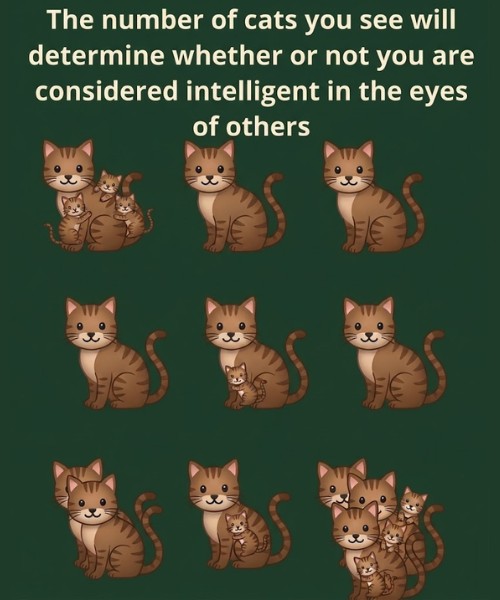
Introduction: A Simple Image That Claims to Measure Intelligence
You are shown an image filled with hidden cats. Some are obvious. Others are cleverly disguised in shadows, shapes, or patterns. The challenge is simple:
Count how many cats you see.
Then comes the statement:
“The number of cats you see determines whether you are intelligent in the eyes of others.”
At first, this feels intriguing. Maybe even a little exciting. You start looking carefully. You count. You recount. You hesitate. You wonder if you missed something.
And then comes the interpretation:
- 9 cats → practical
- 12 cats → perceptive
- 16 cats → highly attentive
- 20+ cats → extremely intelligent
It feels like a test. A judgment. A reflection of your mind.
But here’s the truth:
👉 This is not actually a test of intelligence.
👉 It is a test of perception style, attention, and interpretation.
And more importantly—it reveals something much deeper about how you think, how you approach uncertainty, and how you define “being smart.”
Why These Puzzles Feel So Real (Even When They’re Not Scientific)
Before analyzing the numbers, you need to understand something important.
A Concept to Learn: Cognitive Illusion
A cognitive illusion is when your brain believes something meaningful is happening… even if the connection is weak or symbolic.
These puzzles:
- Feel accurate
- Feel personal
- Feel insightful
Because they:
- Use familiar situations
- Give specific interpretations
- Trigger self-reflection
But they are not measuring intelligence in a scientific way.
What Is Actually Being Measured?
When you look at a hidden-object image, your brain is doing several things:
1. Visual Scanning
You move your eyes across the image.
2. Pattern Recognition
You identify shapes that resemble cats.
3. Attention Control
You decide where to focus.
4. Interpretation
You decide whether something “counts” as a cat.
A Concept to Learn: Perception Style
Your perception style is how you:
- Notice details
- Interpret patterns
- Decide what is relevant
This is what the puzzle is really revealing.
The Meaning Behind Each Range (But Interpreted Correctly)
Let’s go through the numbers—but with deeper understanding, not just surface labels.
Seeing 9 Cats: Focused Simplicity
If you see around 9 cats, it suggests:
You focus on:
- Clear shapes
- Obvious elements
- Direct information
What This Really Means
You are:
- Efficient
- Practical
- Not easily distracted
You don’t waste time searching for things that may not be there.
How Others May Perceive You
- Grounded
- Reliable
- Straightforward
But sometimes:
- They may think you “miss details”
- Even though you are just prioritizing clarity
Seeing 10–11 Cats: Structured Awareness
If you see 10 or 11 cats, you go a step further.
What This Means
You:
- Look beyond the obvious
- But still stay organized
- Don’t get lost in overthinking
Your Strength
Balance.
You combine:
- Observation
- Control
How Others See You
- Logical
- Methodical
- Trustworthy
Seeing 12–13 Cats: Expanding Perception
At 12–13 cats, something changes.
What This Means
You:
- Notice hidden elements
- Explore deeper layers
- Are curious
A Concept to Learn: Depth of Processing
This refers to how deeply you analyze information.
You don’t just see—you interpret.
How Others See You
- Insightful
- Thoughtful
- Observant
Seeing 14–15 Cats: Analytical and Creative Thinking
This range shows a combination of:
- Logic
- Imagination
What This Means
You:
- Look carefully
- But also creatively
- Connect patterns
Your Strength
You don’t just find cats—you discover them.
How Others See You
- Smart
- Flexible
- Interesting thinker
Seeing 16–17 Cats: High Attention and Pattern Sensitivity
Now we enter a deeper level of observation.
What This Means
You:
- Scan thoroughly
- Detect subtle details
- Stay focused longer
A Concept to Learn: Sustained Attention
This is your ability to:
- Stay engaged
- Avoid distraction
- Continue searching
How Others See You
- Sharp
- Detail-oriented
- Intelligent
Seeing 18–19 Cats: Deep Focus and Persistence
At this level, effort becomes important.
What This Means
You:
- Invest time
- Double-check
- Refuse to stop early
Your Strength
Persistence.
How Others See You
- Dedicated
- Disciplined
- Mentally strong
Seeing 20–21 Cats: Exhaustive Analysis
Click page 2 to continue