That sudden pause.
That itch to look again.
That quiet excitement when your brain whispers, “Wait… what was that?”
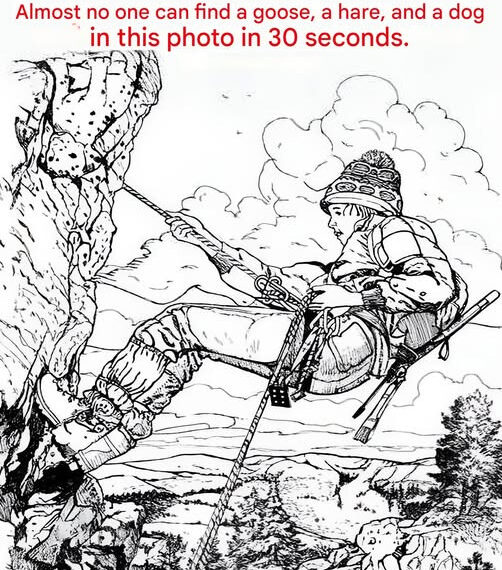
Hidden-image illustrations trigger something deeply human. They invite us to slow down in a world that constantly pushes us to skim, scroll, and move on. At first glance, this mountain scene looks calm, almost ordinary: a climber suspended on a rope, rocks, clouds, a sense of altitude and stillness.
And yet—three animals are hiding in plain sight.
A dog.
A hare.
A goose.
They are not added to the scene.
They are woven into it.
That’s why we miss them.
Let’s take our time and explore where they are, why our eyes overlook them, and why our brains love puzzles like this far more than we realize.
Why We Don’t See What’s Right in Front of Us
When we first look at an image, our brain does something very efficient—and very limiting.
It asks one question:
“What is the main story here?”
In this illustration, the answer is immediate:
- A climber
- A mountain
- Movement and risk
Once that story is locked in, everything else becomes background. Rocks are rocks. Clouds are clouds. Grass is grass.
Your brain filters out anything that doesn’t serve the narrative.
This is not a flaw. It’s how perception works.
Hidden-image artists exploit this beautifully.
The Artist’s Trick: Turning Nature Into Animals
The brilliance of this image lies in its restraint. The animals are not drawn with bold outlines or obvious features. Instead, the artist uses:
- Natural curves of rocks
- Subtle contrasts
- Negative space
- Textures that mimic fur or feathers
Your brain isn’t failing to see the animals.
It’s successfully seeing the landscape—too successfully.
First Mystery: The Loyal Companion Hidden Below
🐕 The Dog
Let’s start with the easiest one… once you know where to look.
At the lower left of the image, near the base of the cliff, you’ll notice a shape that at first appears to be nothing more than uneven stone and shadow. But look again.
What seemed like random texture begins to soften.
- A rounded head emerges
- Two darker spots suggest eyes
- A snout forms from the rock’s contour
- The body blends into the cliff face
The trick here is texture.
The artist uses speckled rock patterns to imitate fur. Our brain is used to seeing dogs as separate, moving beings—on the ground, in familiar settings. We are not prepared to recognize a dog as stone.
And that’s why it hides so well.
Second Challenge: The Long-Eared Illusion
🐇 The Hare
The hare is subtler—and more psychologically sneaky.
Look toward the central area of the image, where rock formations and shadows stretch horizontally. At first, it’s just terrain. But if you slightly relax your focus—almost as if you’re daydreaming—something changes.
- Two narrow, upright shapes appear: ears
- A slender head forms between them
- The body is suggested, not drawn
This hare is not inked boldly. It is suggested by absence—by the spaces between lines rather than the lines themselves.
Why do we miss it?
Because our brains expect hares to:
- Sit in fields
- Run through grass
- Be outlined clearly
Not cling to a mountainside made of stone and shadow.
This illusion works by violating expectation.
Third Appearance: The Most Unexpected Guest
🪿 The Goose
This is the one that frustrates people the most.
Why?
Because no one looks for animals in the sky.
Near the upper part of the image, where clouds meet rock near the summit, light shapes form what seems to be nothing more than mist and altitude. But tilt your head—or mentally rotate the image—and suddenly:
- A long, curved neck appears
- A beak points outward
- The head becomes unmistakable
The goose is hidden using light-on-light camouflage. The artist barely outlines it, allowing clouds and rock edges to do the work.
This illusion depends on angle and patience.
Click page 2 to continue