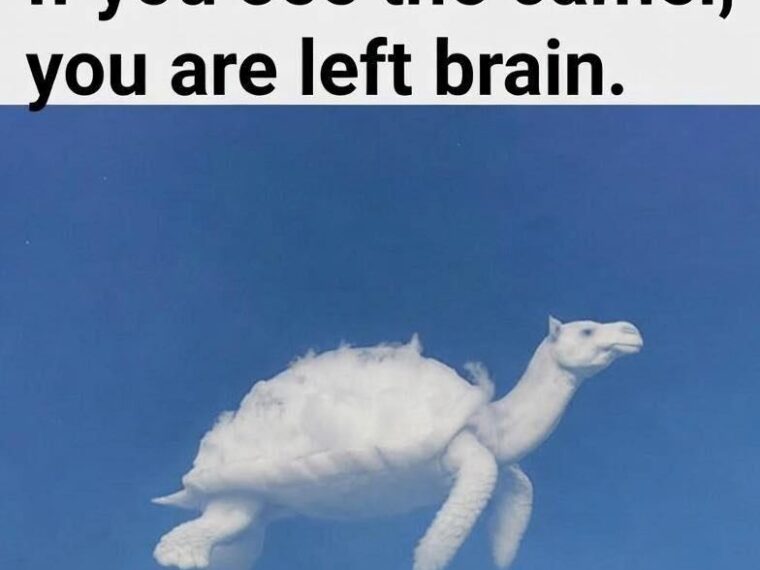
The human brain is a master illusionist. It takes incomplete information, fragmented shapes, shadows, and patterns, and within milliseconds transforms them into something recognizable, familiar, and emotionally charged. This process happens so fast that it feels effortless, almost magical. When confronted with an ambiguous image—one that can be seen as two different things at once—the brain does not hesitate. It chooses. That choice feels instinctive, personal, and revealing. Seeing a turtle or a camel first is not a random event, nor is it a mystical verdict on intelligence or personality. It is a window into how perception works, how habits of thought are formed, and how the brain prioritizes meaning under uncertainty.
Ambiguous images have existed for centuries, long before they went viral on social media. Artists, philosophers, and psychologists have long understood that perception is not passive. The eyes do not simply record reality like a camera. Instead, perception is an active construction shaped by memory, emotion, culture, expectations, and survival instincts. What appears first in the mind says more about processing style than about fixed traits such as creativity or logic.
The turtle and camel illusion is especially interesting because both animals carry deep symbolic weight. The turtle is associated with slowness, protection, patience, endurance through stability, and grounding. The camel represents resilience through adaptation, endurance through movement, survival in harsh environments, and efficiency under pressure. When the brain selects one form before the other, it reveals which mental shortcuts it prefers when making sense of ambiguity.
This does not divide people into rigid categories. The brain is not split cleanly into two personalities. Instead, the illusion highlights dominant tendencies shaped by environment, lifestyle, emotional state, and even fatigue at the moment of viewing. Understanding this helps dismantle simplistic myths while offering a richer, more empowering view of cognition.
HOW THE BRAIN DECIDES WHAT IT SEES FIRST
Vision begins in the eyes but interpretation happens in the brain. Light hits the retina, signals travel through the optic nerve, and within a fraction of a second the visual cortex begins decoding shapes, edges, contrast, and motion. At this stage, the image is still meaningless. Meaning emerges only when higher brain areas compare the raw input with stored memories and patterns.
The brain constantly asks silent questions: What does this resemble? Have I seen something like this before? Is it important? Is it safe? Is it familiar? These comparisons happen automatically, without conscious effort. The first recognizable shape that fits a stored pattern “wins” the competition and becomes the perceived object.
In ambiguous images, multiple interpretations compete. The one that surfaces first is the one that matches the brain’s current biases and expectations most efficiently. These biases are shaped by experience, mood, stress levels, and long-term habits of attention.
A brain trained to notice outlines, textures, and enclosed forms may gravitate toward the turtle. A brain accustomed to identifying posture, direction, and movement may resolve the shape into a camel. Neither is superior. Each reflects a different strategy for reducing uncertainty.
THE MYTH OF LEFT-BRAIN AND RIGHT-BRAIN PERSONALITIES
Popular culture loves the idea that people are either “left-brained” or “right-brained.” One side is said to be logical, analytical, structured. The other is portrayed as creative, emotional, intuitive. This idea persists because it feels intuitive and flattering. However, neuroscience paints a more nuanced picture.
Both hemispheres are involved in almost all cognitive tasks. Language, creativity, reasoning, and emotion emerge from networks that span the entire brain. While certain functions are more lateralized, personality and perception are not governed by a single hemisphere.
The turtle-or-camel illusion does not diagnose hemispheric dominance. Instead, it highlights cognitive style. Cognitive style refers to preferred ways of processing information rather than fixed abilities. Some people favor detail-first processing, while others favor global patterns. Some prioritize familiarity, while others lean toward novelty. These tendencies fluctuate and evolve.
Seeing the turtle first does not mean a person lacks creativity. Seeing the camel first does not mean a person ignores details. The brain is flexible, adaptive, and context-dependent.
SEEING THE TURTLE FIRST: DETAIL, SAFETY, AND INNER RHYTHM
When the turtle emerges first in perception, it often reflects a brain that prioritizes structure, containment, and coherence. The turtle’s shell is a closed, rounded form. It suggests boundaries and protection. Brains that gravitate toward this shape tend to anchor meaning in stability.
This cognitive style often favors depth over speed. Information is processed carefully, step by step. There is comfort in routines, systems, and predictability. This does not imply resistance to change, but rather a preference for integrating change gradually.
In daily life, this may manifest as a strong appreciation for familiarity. People with this tendency often value environments that feel safe and controlled. They may prefer well-defined roles, clear instructions, and dependable rhythms. They tend to notice inconsistencies and small deviations others overlook.
Emotionally, this style often correlates with introspection. Feelings are processed internally before being expressed. Decisions are made after reflection rather than impulse. There is a natural inclination toward grounding practices such as cooking, organizing, journaling, or repetitive crafts.
In creativity, this manifests as refinement rather than explosion. Creative output is often polished, precise, and meaningful rather than spontaneous. The process itself matters as much as the outcome.
SEEING THE CAMEL FIRST: ADAPTATION, MOVEMENT, AND BIG-PICTURE THINKING
When the camel appears first, the brain has resolved the image by focusing on posture, direction, and context rather than enclosure. The camel’s form suggests forward movement, endurance through flexibility, and survival through efficiency.
This cognitive style tends to prioritize patterns over details. The brain quickly synthesizes information into a broader narrative. There is comfort with uncertainty and change. Rules are seen as guidelines rather than absolutes.
In everyday life, this often translates into adaptability. Such individuals may thrive in dynamic environments where improvisation is required. They are often comfortable making decisions with incomplete information, trusting intuition and experience.
Emotionally, this style leans toward external expression. Feelings may be processed through action rather than introspection. Movement, travel, conversation, and experimentation become tools for regulation and understanding.
Creativity here is exploratory. Ideas are generated rapidly, often crossing boundaries between domains. The focus is on possibility rather than perfection. The journey matters more than the structure.
WHY THESE TENDENCIES ARE NOT FIXED
The brain is plastic. Neural pathways strengthen with use and weaken with neglect. A person who currently sees the turtle first may see the camel first at another time. Stress, fatigue, hormonal changes, and emotional context can all shift perceptual priorities.
During periods of anxiety or overwhelm, the brain often seeks safety and predictability. Under these conditions, enclosed forms and stable shapes may dominate perception. During periods of confidence or exploration, the brain may favor open forms and directional cues.
Lifestyle also plays a role. Highly structured routines reinforce detail-oriented processing. Highly variable environments reinforce adaptive processing. Neither is inherently healthier. Balance is key.
PERCEPTION AS A MIRROR OF DAILY HABITS
Perception is not isolated from daily life. The way the brain resolves ambiguity reflects how it approaches choices, relationships, and challenges.
In decision-making, detail-oriented processing leads to careful evaluation of options. Risks are assessed thoroughly. This can prevent errors but may slow progress. Big-picture processing allows faster decisions and creative leaps but may overlook subtleties.
In relationships, a grounding style may prioritize loyalty, consistency, and emotional safety. An adaptive style may prioritize growth, novelty, and shared experiences. Conflict often arises not from incompatibility but from mismatched processing styles.
Understanding these differences reduces unnecessary self-judgment and interpersonal tension. It reframes behavior as strategy rather than flaw.
THE ROLE OF SYMBOLISM IN PERCEPTION
The turtle and camel carry cultural meanings that influence interpretation. Even without conscious awareness, the brain draws on symbolic associations.
The turtle is ancient, often associated with wisdom, longevity, and the Earth itself. It suggests carrying one’s home within oneself. The camel is a traveler, associated with deserts, trade routes, and endurance across vast distances.
These symbols resonate differently depending on personal history. Someone who values home, rest, and introspection may resonate more strongly with the turtle. Someone who values resilience, independence, and exploration may resonate more with the camel.
These associations do not dictate destiny. They simply reflect emotional resonance at a given moment.
AMBIGUITY AS A TRAINING GROUND FOR THE MIND
Click page 2 to continue