Opening the refrigerator and finding limp lettuce, rubbery cucumbers, and carrots that snap no more is a small but deeply frustrating experience. It feels wasteful, confusing, and unfair, especially when those vegetables were fresh only days ago. Most people assume the problem lies with poor-quality produce, long transport times, or bad luck at the market. In reality, the issue is far closer to home. It sits quietly behind a plastic dial or digital setting that almost everyone misunderstands.
Refrigerator temperature is not a background detail. It is the single most important factor in preserving the texture, flavor, and lifespan of vegetables. Yet studies and appliance technicians agree on one surprising fact: the vast majority of households run their refrigerators at the wrong temperature. Not slightly wrong. Significantly wrong.
This mistake does not just shorten shelf life. It actively damages vegetables from the inside out.
WHY THE REFRIGERATOR TEMPERATURE MATTERS MORE THAN YOU THINK
Vegetables are living tissues even after harvest. Their cells continue to respire, lose moisture, and react to their environment. Temperature controls the speed of these processes.
When the refrigerator is too warm, respiration accelerates. Water escapes faster from plant cells, leading to wilting, shriveling, and loss of crunch. Bacteria and mold also multiply more rapidly, increasing spoilage.
When the refrigerator is too cold, something else happens. Cell walls rupture. Ice crystals form inside delicate vegetables, permanently damaging their structure. Once thawed, the vegetable turns soft, watery, and flavorless. This damage is irreversible.
The refrigerator’s job is to slow life down without freezing it. That balance is delicate, and most dials do not make it easy to achieve.
WHY MOST PEOPLE SET IT INCORRECTLY
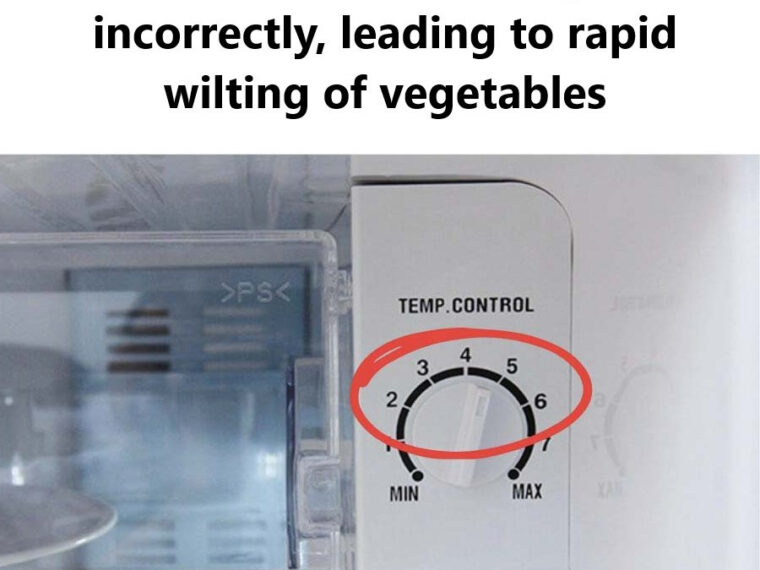
The main reason is deceptively simple: refrigerator dials do not show temperature. They show power level.
Settings labeled “1 to 7” or “Min to Max” do not correspond directly to degrees. They control how long and how intensely the compressor runs. Many people assume turning the dial higher means “better cooling.” In practice, it often means freezing some zones while leaving others unstable.
Another reason is habit. People rarely adjust fridge settings after installation. Seasonal changes, household size, shopping frequency, and room temperature all affect how a refrigerator behaves. A setting that worked in winter may destroy vegetables in summer.
Finally, most people store food without understanding temperature zones inside the fridge. Not all shelves are equal.
THE IDEAL TEMPERATURE RANGE FOR VEGETABLES
Contrary to popular belief, colder is not always better. Vegetables thrive in specific temperature ranges depending on their structure and water content.
The safest general range for vegetable storage is between 3°C and 9°C, but that range must be divided carefully.
Leafy vegetables such as lettuce, spinach, arugula, and kale are highly sensitive to dehydration. Their thin cell walls lose moisture quickly. They perform best at 3 to 5°C, combined with high humidity. Too warm and they wilt. Too cold and they collapse.
Root vegetables like carrots, beets, radishes, and turnips are more resilient. Their dense structure tolerates slightly higher temperatures. They remain crisp at 5 to 7°C, provided humidity is moderate rather than excessive.
Fruit vegetables such as peppers, zucchini, eggplant, and even tomatoes prefer 7 to 9°C. These vegetables suffer chilling injury if stored too cold. Their flavor dulls, and their texture becomes spongy.
Trying to force all vegetables into a single temperature is one of the biggest mistakes people make.
WHY THE VEGETABLE DRAWER EXISTS — AND WHY IT’S OFTEN MISUSED
The vegetable drawer is not just a convenient box. It is a humidity-controlled environment designed to slow moisture loss. Many drawers have adjustable vents that regulate airflow.
Leafy greens benefit from high humidity because it reduces dehydration. Root vegetables prefer lower humidity to prevent rot. Mixing incompatible vegetables in the same drawer creates a microclimate where none of them thrive.
Click page 2 to continue