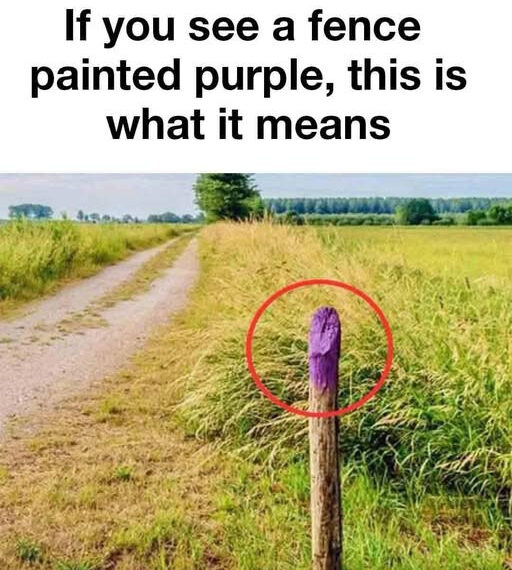
At first glance, a purple-painted fence post or tree can feel puzzling. It doesn’t shout. It doesn’t explain itself. There are no words, no warnings in bold letters, no threatening language. Just a stripe of purple paint standing out against wood, bark, or metal. Many people pass by without giving it much thought. Others assume it is decorative, artistic, or the result of some unfinished maintenance work.
That assumption is where trouble often begins.
In many parts of the United States, a purple-painted fence, gate, or tree is not a stylistic choice. It is not random. It is not harmless. It is a legally recognized warning that you are approaching or crossing private property. In the eyes of the law, that purple paint can carry the exact same authority as a large, clearly written “NO TRESPASSING” sign.
This system exists quietly, efficiently, and largely unnoticed — until someone ignores it.
THE ORIGINS OF THE PURPLE PAINT LAW
The Purple Paint Law did not emerge as a trend or a cultural quirk. It was born out of practical necessity. In rural and semi-rural areas, landowners often manage vast stretches of property that run through forests, fields, hills, and remote terrain. Posting traditional signs along every boundary is expensive, time-consuming, and unreliable.
Signs fall down. They fade. They are stolen. They are shot at. They are damaged by animals, storms, and overgrowth. In some areas, signs disappear faster than they can be replaced.
Lawmakers recognized that landowners needed a better solution — something durable, visible, and legally unambiguous. Purple paint became that solution.
The color choice was deliberate. Purple is rare in natural landscapes, making it immediately noticeable. It does not blend in like green or brown. It remains visible over time. And once people learn its meaning, it becomes unmistakable.
WHY PURPLE IS A LEGAL LANGUAGE, NOT A DECORATION
Purple paint functions as a form of nonverbal legal communication. It removes ambiguity. There is no language barrier. No need for translation. No debate over wording.
In places where the law applies, purple paint communicates one clear message: entry beyond this point is not permitted without permission.
Unlike signs, paint cannot be easily removed without effort. It cannot be quietly taken down in the middle of the night. It cannot be ignored because it “fell off.” It exists as a permanent, passive boundary marker.
This makes it especially valuable for landowners who want clarity without confrontation.
HOW THE MARKINGS MUST APPEAR TO COUNT LEGALLY
The law does not allow sloppy or vague use of purple paint. To be legally valid, the markings must follow specific standards.
The paint must be applied in vertical lines, not random splashes or horizontal strokes. Each stripe must be clearly visible, typically at least one inch wide and eight inches long. Placement matters as well. The stripe must be positioned between three and five feet off the ground, ensuring that it is visible even when grass grows tall or snow accumulates.
Spacing is equally important. Purple paint markings are usually required to appear at regular intervals — often around every 100 feet — along the property boundary. This prevents claims that the warning was easy to miss.
When these conditions are met, the law considers the warning sufficient.
WHERE THIS LAW APPLIES — AND WHY THAT MATTERS
One of the biggest dangers surrounding purple paint is misunderstanding where it applies. Not every state recognizes it. In states that do, courts treat it as legitimate notice. In states that do not, it may carry no legal authority at all.
This creates a patchwork of enforcement that confuses travelers, hikers, hunters, photographers, and outdoor enthusiasts. A purple stripe that carries serious legal weight in one state may mean nothing legally in another.
That is why assuming purple paint is “just paint” is risky. When in doubt, the safest assumption is to treat it as a boundary and stay out unless you have explicit permission.
WHY LANDOWNERS PREFER THIS METHOD
From a landowner’s perspective, purple paint offers several advantages over traditional signage.
It requires little maintenance. Once applied correctly, it can last for years. It is less likely to attract vandalism. It does not clutter the landscape with aggressive warnings. It communicates firmness without hostility.
Many landowners also prefer it because it reduces disputes. There is less room for arguments like “I didn’t see the sign” or “the sign was missing.” The boundary is visually consistent and clearly intentional.
Purple paint also helps protect landowners from liability. If someone enters private land and gets injured, the presence of proper boundary markings strengthens the owner’s legal position.
COMMON MISCONCEPTIONS THAT GET PEOPLE IN TROUBLE
One of the most widespread misconceptions is the belief that trespassing only counts if a sign explicitly says “No Trespassing.” This is false in states with Purple Paint Laws. The paint itself is the notice.
Click page 2 to continue