A Deep Exploration of Visual Choice, Symbolism, and the Psychology of Companionship
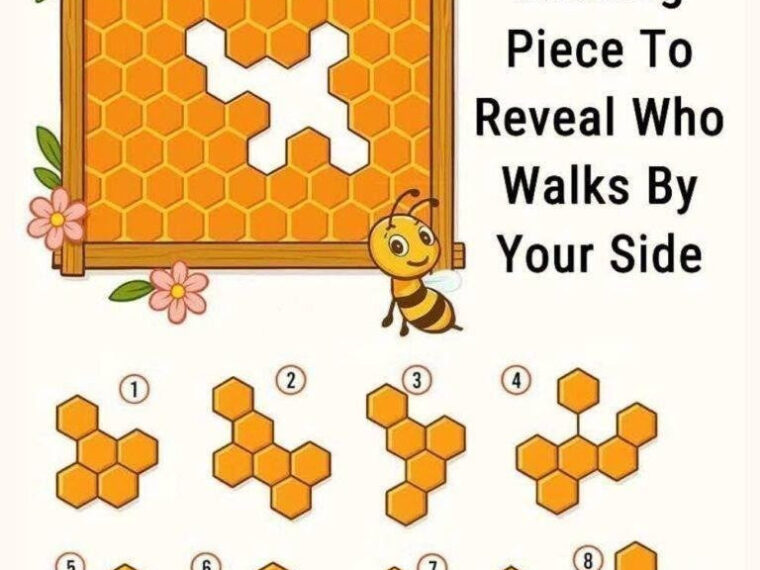
Imagine this: you’re looking at a honeycomb puzzle. One piece is missing. Eight possible shapes sit below, labeled 1 through 8. Your task seems simple — choose the piece that fits.
It feels like a light visual test.
But then comes the twist.
Each choice supposedly reveals something meaningful about the kind of person walking beside you in life — a friend, partner, mentor, guardian, encourager, or even a soulmate.
At first glance, it looks like just another personality quiz.
But here’s where it gets interesting: these kinds of puzzles work not because they magically read your soul, but because they tap into powerful psychological mechanisms — projection, symbolism, and intuitive decision-making.
So let’s do something different.
Instead of simply reading what your chosen piece means, we’re going to explore:
- Why honeycombs are such powerful symbols
- How visual choices reflect emotional priorities
- What each “companion type” represents psychologically
- Why you may be drawn to a specific archetype
- What this says about your inner world — not just the person beside you
This is not fortune telling.
This is symbolic psychology disguised as a puzzle.
And that makes it far more fascinating.
Why a Honeycomb? The Symbolism Behind the Shape
The honeycomb is not a random design choice.
It is one of the most mathematically efficient structures found in nature.
Bees use hexagons because they:
- Maximize storage space
- Minimize material usage
- Distribute weight evenly
- Interlock perfectly without gaps
The hexagon is geometry’s quiet genius.
So when you look at a honeycomb puzzle missing a piece, your brain doesn’t just see shapes.
It sees incompleteness.
It sees a gap in a system that is meant to be whole.
Symbolically, that missing piece becomes:
- A representation of connection
- A metaphor for belonging
- A reflection of the relationships that “complete” us
Your choice is not about spatial intelligence.
It is about emotional resonance.
The Psychology of Choosing Without Overthinking
When you’re told not to overthink and simply “choose what feels right,” something important happens.
You bypass analytical reasoning and move into intuitive cognition.
Intuition is not mystical. It is rapid pattern recognition shaped by experience, memory, and emotional associations.
You are not randomly choosing.
You are selecting the shape that feels most harmonious.
And harmony, psychologically, reflects internal needs.
Now let’s explore what each archetype represents — not as prediction, but as mirror.
If You Chose Piece 1 – The Supportive Friend
This archetype represents emotional stability.
The supportive friend is steady, grounded, reliable.
You may be drawn to this piece if:
- You value emotional safety
- You crave consistency
- You have experienced instability before
- You prioritize calm over excitement
Supportive figures regulate nervous systems.
They don’t create chaos.
They reduce it.
Choosing this piece may reveal that what matters most to you is not intensity — but reliability.
You may define companionship as:
“I know you’ll be there.”
And psychologically, that reflects a deep appreciation for security.
If You Chose Piece 2 – The Loyal Partner
Loyalty is about endurance.
This archetype represents long-term attachment, commitment, and emotional depth.
If this piece felt right, you may value:
- Shared goals
- Emotional reciprocity
- Partnership over independence
- Stability in love
This suggests you measure connection by:
“Will you stay?”
You are less interested in fleeting excitement and more drawn to bonds that survive storms.
Loyalty reflects attachment security.
It signals a preference for emotional rootedness rather than novelty.
If You Chose Piece 3 – The Protective Guardian
Protection is power directed outward.
The guardian archetype symbolizes safety and foresight.
You may resonate with this if:
- You often feel responsible for others
- You admire strength and vigilance
- You value guidance and protection
- You associate love with shielding
Choosing this piece suggests you equate companionship with security.
Not emotional softness alone — but active safeguarding.
You may feel safest when someone anticipates danger before you do.
That reveals something powerful about how you process vulnerability.
If You Chose Piece 4 – The Inspirational Dreamer
This archetype is forward-looking.
The dreamer represents possibility, imagination, expansion.
If this piece drew you in, you likely value:
- Growth
- Creativity
- Big ideas
- Vision
You may feel most alive around people who:
- Challenge limitations
- Encourage ambition
- Inspire courage
Choosing this suggests your emotional fulfillment is tied to expansion.
You don’t just want comfort.
You want elevation.
And that says something about your internal hunger for growth.
If You Chose Piece 5 – The Honest Truth-Teller
Honesty is sharp but clean.
The truth-teller archetype represents authenticity and directness.
You may resonate with this if:
- You value clarity over comfort
- You dislike ambiguity
- You respect blunt honesty
- You equate love with accountability
Choosing this piece suggests you trust those who challenge you.
You may prefer uncomfortable truth over soothing illusion.
That signals emotional maturity.
It reveals that growth matters more to you than constant validation.
If You Chose Piece 6 – The Energetic Encourager
Energy is contagious.
This archetype represents enthusiasm, vitality, and optimism.
If you chose this, you may value:
- Motivation
- Emotional uplift
- Celebration
- Momentum
You likely thrive around people who amplify your energy.
Click page 2 to continue