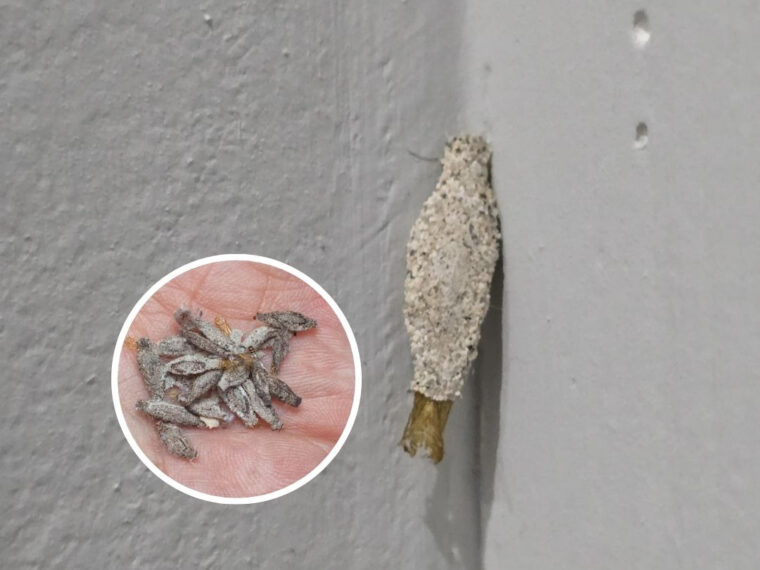
You are brushing your teeth before bed.
The house is quiet. The light hums softly above the mirror. Water drips once, twice, into porcelain.
Then something shifts.
Not dramatically. Not like a flutter or a sudden dart.
But a slow, deliberate movement along the bathroom wall.
A shape you had dismissed as peeling paint, as an uneven patch of plaster, as shadow — moves.
Your breath pauses.
In that moment, your brain scrambles. Pattern recognition misfires. The world you thought was static reveals a seam.
You have not encountered a supernatural presence.
You have encountered one of nature’s most refined survival strategies: extreme camouflage.
Now, let’s pause here.
Before we continue the story as written, we need to ground it in biological reality.
There is no scientifically recognized species called the “Kamitetep moth.”
But the phenomenon described — a moth so perfectly camouflaged it appears to be part of a wall — is very real.
And it is far more fascinating than fiction.
This article will explore:
• The real moth species capable of architectural camouflage
• The evolutionary science of extreme disguise
• Why walls are attractive resting sites
• The life cycles of cryptic moths
• How stillness becomes survival
• What this teaches us about perception
Because sometimes the most astonishing discoveries are not mythical creatures.
They are real organisms hiding in plain sight.
Camouflage So Good It Feels Supernatural
The moth you see on your wall likely belongs to one of several groups known for extreme camouflage, particularly within the family Geometridae or Noctuidae.
Species like the peppered moth (Biston betularia) or various “plaster moths” and “litter moths” have evolved wing patterns that mimic:
• Bark
• Stone
• Concrete
• Stucco
• Cracked paint
• Weathered wood
When their wings fold flat against a vertical surface, their bodies disappear into the texture.
This is not magic.
It is millions of years of selective pressure refining invisibility.
Not Camouflage — Integration
Most camouflage works by resemblance.
But some moths go further.
They eliminate:
• Shadows
• Reflections
• Recognizable outlines
Their wings:
• Fold flush against surfaces
• Spread flat to reduce dimensional cues
• Contain mottled pigmentation
• Display fracture-like lines
Predators detect prey through:
• Motion
• Contrast
• Edge detection
• Shadow differentiation
These moths defeat all four.
They do not merely hide on the wall.
They become statistically indistinguishable from it.
This phenomenon is known as cryptic coloration — and in extreme cases, masquerade mimicry.
The Science of Stillness
Movement reveals.
Stillness protects.
Many cryptic moths enter a state of reduced activity during daylight hours. Their metabolism slows. They remain motionless for long periods.
This behavior is adaptive.
Birds, their primary predators, rely heavily on motion detection.
By remaining perfectly still, the moth reduces detection probability dramatically.
This is not passive behavior.
It is an active survival strategy.
Some species can remain motionless for days if undisturbed.
Why Your Home Is Attractive to Them
Modern houses unintentionally mimic natural rock faces and tree trunks.
Consider your wall:
• Vertical
• Light-colored
• Textured
• Dry
• Thermally stable
To a moth evolved to rest on cliffs or tree bark, drywall and plaster are suitable substitutes.
Bathrooms, especially, offer:
• Warmth
• Limited airflow
• Minimal predators
• Occasional small insects
It is not an invasion.
It is ecological opportunism.
Urban environments create new resting habitats.
Thermal Refuge: Why Concrete and Plaster Matter
Stone, concrete, and drywall retain heat.
They buffer against:
• Sudden temperature drops
• Rapid humidity shifts
• Wind exposure
For small insects, thermal stability is life-preserving.
High corners of rooms often:
• Remain dry
• Experience less disturbance
• Offer fewer predators
It’s not that your house “welcomes” them.
It simply resembles a safe vertical landscape.
The Myth of the Wall Guardian
While “Kamitetep moth” may not be a scientific name, humans have long assigned symbolic meaning to camouflaged insects.
Across cultures:
• Moths represented transition
• Nocturnal creatures symbolized watchfulness
• Silent animals suggested guardianship
The human brain interprets stillness as awareness.
When something is so well-hidden that it feels intentional, we attribute purpose.
But evolution requires no mysticism.
Only survival advantage.
The Life Cycle of a Camouflaged Moth
Let’s examine what truly happens biologically.
Egg Stage
Moth eggs are often laid in:
• Cracks
• Crevices
• Under surfaces
• Near food sources
Some species cover eggs with dust-like secretions for concealment.
This is not plaster mimicry — but protection from predators and dehydration.
Larval Stage (Caterpillar)
Many cryptic species have larvae that mimic:
• Twigs
• Lichen
• Bark
Geometer moth caterpillars are famous “inchworms.”
They hold themselves stiffly to resemble sticks.
This is called behavioral mimicry.
Pupal Stage
Cocoons may resemble:
• Debris
• Cobwebs
• Soil clumps
Again, concealment is survival.
Adult Stage
Adults emerge to:
• Mate
• Lay eggs
• Continue lineage
Some adult moths have reduced or non-functional mouthparts.
Others feed lightly on nectar.
Most live only weeks.
Their primary task is reproduction.
Do They Damage Homes?
Here is the grounded truth:
Most camouflaged wall-resting moths are harmless.
Adults:
• Do not chew drywall
• Do not eat clothing
• Do not infest furniture
Some species (like clothes moths) do damage fabric — but they are distinct and identifiable.
The typical wall-mimicking moth is solitary and non-destructive.
Larvae may feed on:
• Organic debris
• Lichens
• Plant material
Rarely on structural materials.
Why You Rarely Notice Them
Because they are designed not to be noticed.
Human vision prioritizes:
• Movement
• Color contrast
• Pattern disruption
When an organism eliminates these cues, it vanishes.
Studies in predator-prey detection show that camouflage reduces detection rates exponentially.
Entomologists often find cryptic moths by:
• Intentionally scanning surfaces slowly
• Looking for symmetry
• Waiting for motion
We walk past them daily.
They are not rare.
They are unseen.
What Happens If You Touch It?
Click page 2 to continue