Introduction: The Small Detail That Raises Big Questions
At some point—often quietly—you begin to notice changes in your body that you never paid attention to before. One of the most common is the appearance of thin vertical lines running from the base of your nails to the tip. At first, you might ignore them. Then you notice they are becoming more visible. Maybe your nails feel slightly rougher. Maybe they break more easily.
And naturally, a question appears:
Is this normal… or is it a warning sign?
This is a very important question, because nails are not just cosmetic. They are biological structures that reflect what is happening inside your body. Changes in nails can be harmless—but sometimes they can also be subtle indicators of deeper imbalances.
In this article, you will learn everything in depth:
- What vertical nail ridges really are
- Why they appear after 40
- The difference between normal aging and warning signs
- What your body might be telling you
- How to improve nail health naturally and effectively
And most importantly, you will learn how to observe your body intelligently instead of reacting with fear.
Understanding Vertical Nail Ridges: What Are These Lines?
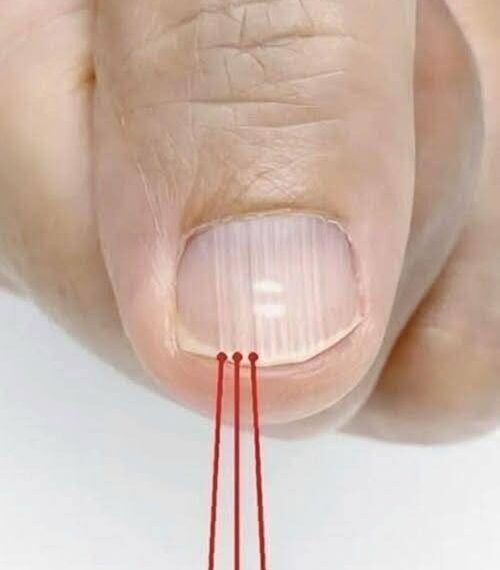
Vertical ridges—also called longitudinal ridges or striations—are lines that run from the cuticle (base of the nail) to the tip.
They can vary:
- Very fine and barely visible
- Slightly raised and textured
- Deep and noticeable
What Your Nail Is Made Of
To understand these ridges, you need to understand the nail structure.
Your nails are made of:
- Keratin (a protein also found in hair and skin)
- Produced by the nail matrix (under the cuticle)
When the matrix produces keratin evenly → smooth nails
When production becomes uneven → ridges appear
Key Concept
👉 Nail texture reflects how evenly your body produces keratin.
Why Vertical Ridges Become More Visible After 40
This is where most people misunderstand.
Vertical ridges are extremely common after 40—and in most cases, they are completely normal.
1. Natural Aging Process
As you age:
- Cell turnover slows down
- Keratin production becomes less consistent
- Nails grow more slowly
This creates:
- Uneven layers
- Slight structural changes
- Visible ridges
This is similar to:
- Wrinkles in the skin
- Gray hair
👉 It is a structural change, not necessarily a problem.
2. Nail Dehydration (One of the Most Overlooked Causes)
With age:
- Skin becomes drier
- Nails lose moisture
Dry nails:
- Become brittle
- Show ridges more clearly
- Break more easily
External factors worsen this:
- Frequent hand washing
- Cleaning products
- Exposure to water
Important Insight
Sometimes, the problem is not inside your body—it is simply lack of hydration.
3. Nutritional Deficiencies (Subtle but Important)
As metabolism changes with age, your body may absorb nutrients less efficiently.
Deficiencies that affect nails include:
- Biotin (Vitamin B7) → nail strength
- Iron → oxygen delivery to cells
- Zinc → tissue repair
- Magnesium → structural health
When these are low:
- Nails become weaker
- Growth becomes uneven
- Ridges appear more pronounced
4. Reduced Blood Circulation
Circulation naturally decreases with age.
Poor circulation:
- Reduces nutrient delivery to nail matrix
- Slows regeneration
- Affects nail quality
5. Hormonal Changes
Hormonal shifts affect:
- Skin
- Hair
- Nails
Changes in thyroid or other hormones can:
- Alter nail texture
- Increase brittleness
When Vertical Ridges Are NOT Just Aging
Most ridges are harmless—but not always.
You Should Pay Attention If You Notice:
- Dark lines or streaks (especially black or brown)
- Rapid changes in nail appearance
- Splitting, peeling, or thickening
- Pain or swelling around nails
These could indicate:
- Fungal infections
- Trauma
- Circulatory issues
- In rare cases, serious conditions
Important Rule
👉 Change + symptoms = check
👉 Stable ridges alone = usually normal
The Psychology of Noticing Body Changes
There is something deeper happening when you notice these lines.
You begin to:
- Observe your body more
- Question changes
- Feel uncertainty
And this can create anxiety.
But here is the shift you need:
👉 Not every change is a problem
👉 Some changes are information
Learning to observe without panic is a skill.
How to Improve Nail Health Naturally (Step-by-Step System)
Now we move into solutions.
1. Hydration: The Foundation of Healthy Nails
This is the simplest and most effective step.
What to Do
Click page 2 to continue