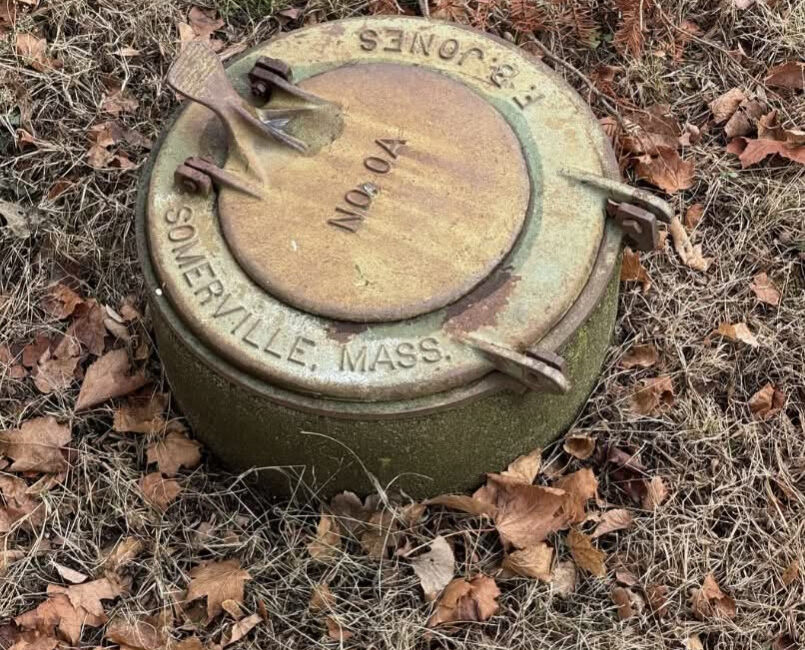
A few weeks ago, I got a call from a friend asking me to check out something strange in their backyard. Hidden beneath a blanket of dried grass and leaves was an old, rusted metal hatch. It looked solid, almost indestructible, and had the stamp of “Somerville, Mass.” imprinted on it. At first glance, we had no idea what it was. A water tank? A utility vault? The possibilities seemed endless. But after a little digging—both literal and digital—we uncovered the mystery: it was an underground garbage can. Yes, you read that right—an underground trash container. These relics of New England’s past became a window into a long-forgotten way of handling garbage.
If you’ve never heard of underground garbage cans before, you’re not alone. For decades, they were common features in suburban New England neighborhoods, but over time, they’ve faded into obscurity. Today, finding one is like discovering a hidden piece of history—an odd yet fascinating artifact from a time when people thought differently about waste and convenience.
A Peek Into the Past: Life Before Curbside Pickup
To understand the significance of these buried trash cans, we have to go back to the mid-20th century. This was a time before the modern curbside trash pickup system, and certainly before the big plastic bins we rely on today. Back then, the trash situation was a bit more… hands-on.
Families relied on metal trash cans to store their waste, but these were far from ideal. Heavy rains and strong winds would knock them over, leaving garbage scattered across the yard. As if that wasn’t bad enough, over time, metal trash cans would rust and corrode, turning them into unsightly eyesores. And let’s not forget about the raccoons, squirrels, and other critters that would find their way into these cans, creating a literal buffet for local wildlife. It wasn’t a pleasant situation, and the smell was often unbearable.
Enter the underground garbage can.
In suburban New England, people needed a better solution—one that kept their trash hidden, sealed, and away from pests. The underground garbage can was born. Imagine a metal can, half-buried in the ground with only the lid peeking above the surface. The trash went into the container, and once the lid was closed, everything was kept neatly out of sight and smell. Animals couldn’t access the trash, and the cans were less prone to getting knocked over in bad weather.
For homeowners, it was a simple setup. Just open the lid, toss in your garbage, close it, and forget about it until trash day. It worked for a while—and it worked well.
The Sanitation System: How It Worked
What set underground garbage cans apart was not just their design but the way they fit into the local sanitation system. Sanitation workers had their own method for handling these buried trash cans. Every week or so, they’d drive down the street, open the hatch to each can, pull out the metal container, empty it, and then return it to its hole in the ground. It wasn’t a high-tech process, but it worked well for the time.
The lid would often be stamped with the name of the town or the manufacturer, such as “Somerville” or “F.S. Jones,” giving a sense of locality and personalization to each can. These cans weren’t just pieces of trash equipment—they were part of the community.
Why Did They Disappear?
By the 1970s, the underground garbage can began to fade away. As suburban neighborhoods expanded, curbside trash pickup became the new norm. In addition to being more convenient for both homeowners and sanitation workers, curbside bins were lighter, easier to move, and less likely to rust out over time. They could be emptied easily with the advent of mechanical systems, making the underground cans look like old-fashioned relics of a bygone era.
But that wasn’t the only reason these underground cans started disappearing. Over the years, the metal containers were prone to rusting out, especially given New England’s harsh winters and wet climate. Once water filled the cans, they became a breeding ground for bacteria and mold, turning what was once a clever solution into a maintenance nightmare. Many homeowners eventually had their underground cans sealed or removed altogether, favoring more practical, portable alternatives.
Though the underground garbage can was a unique solution, it simply couldn’t compete with the ease and practicality of curbside pickup. Over time, they became a thing of the past—tucked away beneath layers of dirt, forgotten by most, and left to fade into obscurity.
Rediscovering Forgotten Relics
Fast forward to today, and finding an underground garbage can in your backyard is like stumbling upon a time capsule. These relics, often buried deep beneath layers of leaves, dirt, and grass, offer a rare glimpse into how people used to live. Most of the time, they’re forgotten and overlooked, only rediscovered when someone happens to come across a rusty lid poking through the soil.
When we unearthed the old hatch in my friend’s backyard, we had no idea it was part of this fascinating history. But once we started looking into it, we realized how these forgotten garbage cans are a reminder of how life used to be. It was a time when people were inventive, resourceful, and hands-on about solving everyday problems. The underground garbage can was a solution built from practicality and necessity, shaped by the challenges of the time.
Creative Reuse: New Life for an Old Trash Can
Once you uncover an underground garbage can, what do you do with it? Surprisingly, many people have found creative ways to give these old metal containers a second life. Some repurpose them as planters, filling them with flowers, herbs, or vegetables, and turning them into quirky garden features. Others use them as storage bins or make them into unique yard decorations.
click page 2 to continue