Another common error is storing fruits that emit ethylene gas, such as apples, near vegetables. Ethylene accelerates ripening and decay, especially in leafy greens.
Understanding the drawer’s purpose transforms it from a storage bin into a preservation tool.
THE HIDDEN PROBLEM OF UNEVEN TEMPERATURE
Even if the dial is set correctly, temperature inside a refrigerator is not uniform. Cold air sinks. Warm air rises. The back of the fridge is colder than the front. Door shelves fluctuate the most.
This means that vegetables placed in the wrong spot may experience temperature swings that cause condensation, dehydration, or freezing.
Overloading the refrigerator worsens this problem. When air cannot circulate, cold pockets form. Vegetables in those pockets freeze while others spoil.
Spacing is not wasteful. It is functional.
WHY A THERMOMETER IS MORE IMPORTANT THAN THE DIAL
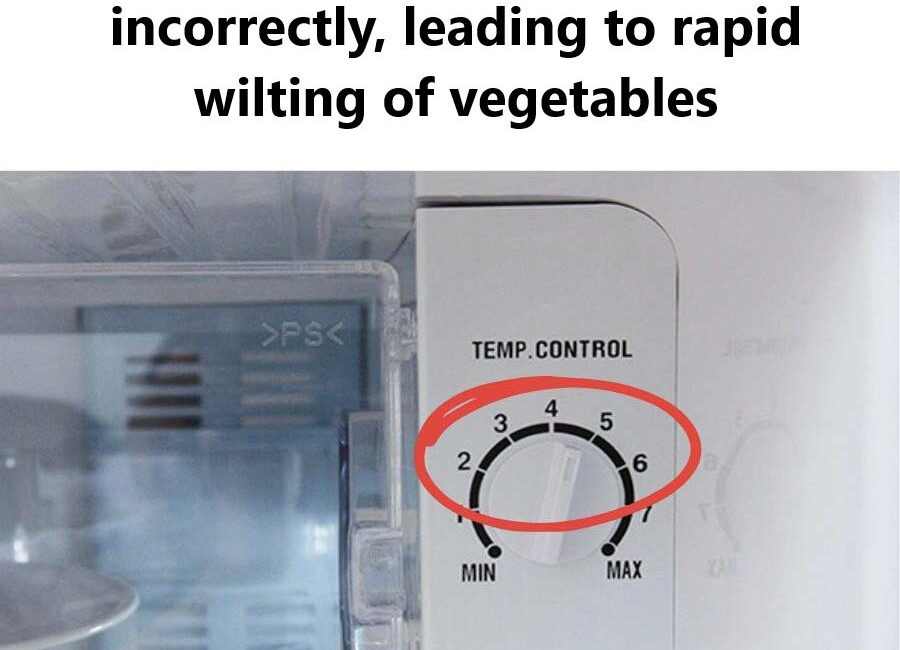
Relying on the refrigerator’s built-in dial is guesswork. A simple refrigerator thermometer removes uncertainty.
Placing thermometers in different zones reveals surprising differences. One shelf may be 2°C while another sits at 8°C. Without measuring, these variations remain invisible.
Once identified, food placement becomes strategic instead of random. Vegetables go where they belong. Dairy stays in stable zones. Waste decreases.
This small tool often saves more money than it costs within weeks.
HOW INCORRECT TEMPERATURE DRAINS FLAVOR, NOT JUST FRESHNESS
Wilting is visible. Flavor loss is subtle but just as damaging.
Cold stress reduces aromatic compounds in vegetables. Warm storage accelerates sugar breakdown. The result is produce that looks acceptable but tastes bland.
This is why home-cooked meals sometimes feel less vibrant even with fresh ingredients. The problem began in the refrigerator days earlier.
Correct temperature preserves not only structure, but character.
THE LONG-TERM COST OF GETTING IT WRONG
Food waste is not just a financial issue. It is an energy issue. Growing, transporting, and refrigerating vegetables consumes resources. Throwing them away because of preventable storage mistakes compounds that waste.
Over time, incorrect temperature settings also strain the refrigerator. Compressors work harder. Energy consumption rises. Appliance lifespan shortens.
A small adjustment creates a cascade of benefits.
HOW TO RESET YOUR REFRIGERATOR THE RIGHT WAY
The goal is balance, not extremes. The main compartment should stabilize around 3 to 5°C. Vegetable drawers should sit slightly warmer, between 6 and 9°C, depending on contents.
Airflow must be unobstructed. Food should be organized by temperature sensitivity, not convenience. Thermometers should be used periodically, especially when seasons change.
Once dialed in, vegetables last longer, look better, and taste closer to the day they were harvested.
THE REAL REASON 95% OF PEOPLE GET IT WRONG
It is not ignorance. It is assumption.
People assume refrigerators are smarter than they are. They assume colder equals safer. They assume one setting fits all foods. They assume food spoilage is inevitable.
In reality, refrigerators are tools, not caretakers. They require understanding.
Vegetables are not fragile because they are weak. They are fragile because they are alive.
When temperature respects that fact, freshness stops being a matter of luck and becomes a matter of design.
And once you see the difference, wilted vegetables start to feel less like bad fortune and more like a solvable problem that was hiding in plain sight all along.