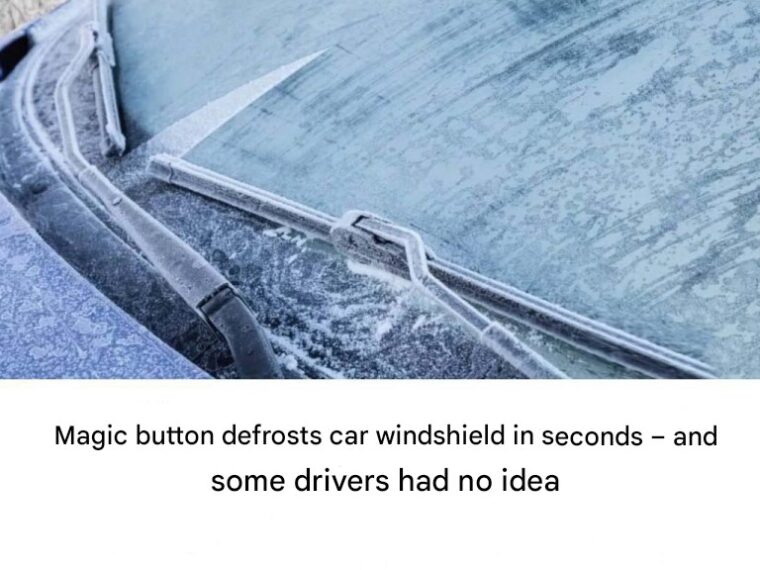
Every winter, the same ritual plays out.
You walk outside.
Your windshield looks like it was dipped in powdered sugar.
You start the engine.
You sit.
You wait.
You scrape.
You question your life choices.
And yet, inside most modern cars, there’s a small button — often ignored — that can clear your windshield dramatically faster than brute-force scraping alone.
It’s not magic.
It’s thermodynamics, airflow physics, and a bit of clever automotive design.
Let’s unpack what this “magic button” really is, how it works, and why so many drivers never use it properly.
First: What Is the “Magic” Button?
It’s the front windshield defrost button, usually marked by:
- A curved windshield icon
- Three upward wavy arrows
- Sometimes labeled “MAX DEFROST”
That’s it.
No hidden tech. No secret lever. Just a symbol most people glance at without thinking.
Yet pressing it activates a carefully engineered chain reaction inside your car’s climate system.
Why Frost Forms on Your Windshield in the First Place
Let’s zoom out for a second.
Frost forms when:
- The glass temperature drops below freezing.
- Moisture in the air condenses.
- That condensation freezes into ice crystals.
Glass cools faster than metal because it radiates heat efficiently. So your windshield often becomes colder than the surrounding air overnight.
Cold glass + humid air = frost.
Simple physics.
Now, removing frost isn’t just about melting ice. It’s about changing the conditions that created it.
That’s where the defrost system comes in.
What Happens When You Press the Defrost Button?
When you press that button, your car does several things at once:
- Turns on the heater at high output
- Directs airflow specifically to the windshield
- Engages the air conditioning compressor
- Adjusts fan speed automatically
- Often switches to fresh air intake
This combination isn’t random. It’s strategic.
Let’s break down why each part matters.
Why the Air Conditioner Turns On During Defrost (Yes, Even in Winter)
This surprises people.
“Why is my AC on? It’s freezing outside!”
Because AC doesn’t just cool air.
It removes moisture.
The AC system pulls humidity out of the air before blowing it onto your windshield.
Dry air melts ice faster than humid air because:
- Humid air slows evaporation.
- Dry air absorbs moisture more efficiently.
So the AC is acting as a dehumidifier.
Less moisture = faster clearing.
Not magic.
Psychrometrics. (That’s the science of moist air behavior.)
Heat Alone Isn’t Enough
If you only blast hot air without dehumidifying it, you can:
- Melt the top layer of frost
- Create water droplets
- Increase interior fogging
That’s why some drivers notice their windshield fogs up more after using heat alone.
Heat + dry air = effective defrost.
Heat + humid air = temporary mess.
Why It Works Faster Than Scraping Alone
Scraping removes surface ice.
Defrost changes the entire temperature of the glass.
Glass conducts heat slowly. But once it warms slightly above freezing, frost stops forming.
So defrosting isn’t just clearing ice — it prevents re-freezing while you drive.
Scraping alone can’t do that.
The Common Mistake Most Drivers Make
Many drivers:
- Start the engine
- Turn on regular heat
- Leave air on foot or mixed mode
- Wait impatiently
But if airflow isn’t directed fully at the windshield, you’re wasting heat.
The “MAX DEFROST” setting overrides your manual adjustments and optimizes everything instantly.
It’s essentially your car saying:
“Relax. I’ve got this.”
Why Some Drivers Say It Works “In Seconds”
Now let’s be realistic.
It won’t clear a thick ice sheet in two seconds.
But compared to passive warming?
Yes — it feels dramatically faster.
Within 30–60 seconds, you’ll often see:
- Frost turning translucent
- Ice loosening
- Visibility returning in streaks
That quick visual shift feels magical.
But it’s just rapid humidity control combined with heat transfer.
The Science Behind Rapid Defrosting
Three processes happen simultaneously:
- Conduction – Heat transfers from air to glass.
- Convection – Warm air circulates across the windshield.
- Evaporation – Melted frost evaporates in dry airflow.
Because all three occur together, clearing accelerates.
Isolated heat alone would be slower.
Isolated airflow alone wouldn’t melt frost.
The synergy is the key.
What About Rear Window Defrost?
Rear windows work differently.
They use:
- Embedded heating wires
- Electrical resistance
- Direct heat conduction
That’s why rear defrost looks like thin horizontal lines.
Front windshields typically don’t have visible heating wires (except in some advanced models).
So the front relies on airflow instead.
Can Using Defrost Damage the Windshield?
Some worry about cracking glass from temperature shock.
That risk exists only if:
- You pour boiling water on frozen glass.
- There’s pre-existing structural damage.
- The temperature difference is extreme and sudden.
The car’s defrost system warms gradually.
It’s engineered to avoid thermal stress.
So no — using the button won’t crack your windshield.
Boiling water might.
Don’t do that.
Pro Tip: The Fastest Way to Defrost Properly
If you want maximum speed:
- Start the engine.
- Immediately press MAX DEFROST.
- Turn off recirculation if it’s on.
- Keep doors closed to retain heat.
- Wait 30–90 seconds before scraping.
You’ll notice frost softens dramatically.
Scraping then becomes effortless.
Why Recirculation Slows Defrosting
Recirculation keeps cabin air cycling.
But that air is humid from:
- Your breath
- Wet shoes
- Snow on clothes
Humid air slows defrost.
Fresh outside air is typically drier in cold weather.
Dry air absorbs moisture better.
So turning off recirculation helps.
Why Cold Weather Makes Air Drier
Here’s a subtle but important detail.
Cold air holds less moisture than warm air.
So winter air is naturally dry.
That’s why static shocks increase in winter.
That dryness is actually helpful for defrosting.
Click page 2 to continue