There’s a very specific kind of fear that hits you when you see something long, dark, and moving through grass.
Your brain doesn’t hesitate.
It doesn’t analyze.
It doesn’t rationalize.
It whispers one word:
Snake.
That’s exactly what happened yesterday at noon.
The sun was high. The air was still. I stepped into my garden, coffee in hand, ready to enjoy the calm.
Then I saw it.
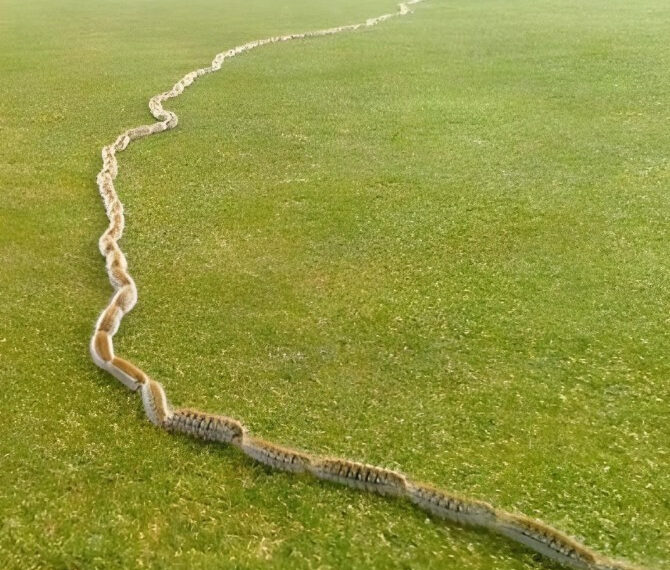
A thick, winding shape stretched across the lawn.
It wasn’t slithering fast. It wasn’t aggressive. It just… moved.
Slowly.
Deliberately.
My first thought was harmless enough:
“Who left a rope in the yard?”
But something about it felt wrong.
Too organic.
Too fluid.
That’s when the second thought arrived — sharp and immediate:
“What if that’s a snake?”
My heart rate jumped. My body stiffened. Adrenaline surged.
And yet, curiosity overpowered caution.
I stepped closer.
That’s when I realized it wasn’t a snake.
And somehow, that made it even stranger.
What I Actually Saw: A Living Chain
As I leaned in, the “rope” didn’t slither like a serpent.
It rippled.
It pulsed.
Tiny movements, synchronized, like a wave traveling through a body.
Because it wasn’t one body.
It was dozens.
No — hundreds.
Caterpillars.
At least 150 of them.
Maybe more.
They were moving nose-to-tail in perfect formation, forming a continuous, living chain over two feet long.
No gaps.
No confusion.
No hesitation.
Just a steady, silent procession across my yard.
It looked unnatural. Almost staged.
Like something out of a nature documentary — except it was happening five feet from my shoes.
What Is a Caterpillar Procession?
What I witnessed is a real biological behavior known as a caterpillar procession.
Certain species — most famously the pine processionary caterpillar (Thaumetopoea pityocampa) — move in long, single-file lines.
This behavior has been observed in:
- Europe
- North Africa
- Parts of Asia
- Some regions of North America (with related species)
Other caterpillars, such as tent caterpillars and forest caterpillars, also display similar marching behavior.
It looks eerie.
But it’s not random.
It’s strategy.
Why Do They Move Like That?
At first glance, it looks theatrical — like a tiny parade with no audience.
But there’s biological logic behind it.
Here’s how it works:
The lead caterpillar lays down a silk trail and releases pheromones — chemical signals that guide the others.
Each follower:
- Touches the one ahead with its antennae
- Follows the silk thread
- Stays in tight formation
This formation serves several purposes:
1. Safety in Numbers
Predators are less likely to attack a large, moving mass.
2. Navigation
They move together toward a specific destination — often a new feeding site or a safe place to pupate.
3. Energy Efficiency
Following a trail reduces confusion and wasted movement.
It’s coordinated. Efficient. Almost militaristic.
Nature doesn’t waste motion.
Why It Felt So Terrifying
Even though caterpillars are harmless-looking individually, seeing 150 of them behaving like a single organism triggers something primal.
Our brains are wired to react to:
- Unexpected movement
- Unfamiliar patterns
- Collective motion
Mass movement in animals can signal danger — swarming insects, migrating snakes, stampeding mammals.
So when you see what looks like one long, living rope, your instinct fires before your logic catches up.
Fear isn’t weakness.
It’s pattern recognition misfiring for a second.
Should You Be Concerned?
In most cases, no.
Caterpillar processions are not aggressive.
They are not hunting.
They are migrating.
However, there are a few important cautions:
Some species — including pine processionary caterpillars — have irritating hairs that can cause:
- Skin rashes
- Eye irritation
- Respiratory issues
- Reactions in pets
Dogs are particularly vulnerable because they sniff everything.
So the rule is simple:
Observe, don’t interfere.
Do not:
- Touch them
- Break the line
- Attempt to sweep them away
- Let pets near them
They are simply passing through.
And they’ll disappear as mysteriously as they appeared.
Where Were They Going?
That part fascinates me most.
Caterpillar processions often occur when the group is:
Click page 2 to continue