They may persist through winter.
They don’t vanish quickly.
They dry and remain visible long after spores release.
That’s why they seem permanent.
Part X: Why They Feel “Alien”
Fungi don’t behave like plants.
They don’t have:
- Leaves
- Flowers
- Green color
- Obvious growth patterns
They emerge suddenly.
They defy familiar plant structure.
And anything unfamiliar triggers unease.
But unfamiliar doesn’t mean dangerous.
It means under-observed.
Part XI: Should You Remove Them?
You can remove them if:
- You dislike the appearance.
- You want aesthetic uniformity.
- You’re worried about pets.
But removal only eliminates the fruiting body.
The underground mycelium remains.
If wood remains, they may reappear.
The only permanent removal method is:
Remove buried wood source.
Which often means digging up old roots or replacing mulch.
Most homeowners choose to simply leave them.
They eventually decompose.
Part XII: The Ecological Importance of Decomposition
Let’s zoom out.
If fungi stopped working:
Dead wood would accumulate for decades.
Carbon cycling would slow.
Soil would lose fertility.
Plant life would weaken.
Fungi convert:
Dead wood → nutrients → soil → plant growth.
They are silent recyclers.
Without them, forests would choke on their own remains.
Dead Man’s Fingers is performing an invisible service.
Part XIII: Cultural Symbolism of Black Fungi
Throughout history, unusual fungi were:
- Considered omens
- Associated with death
- Linked to folklore
- Feared due to appearance
Black growth emerging from earth taps into primal symbolism.
Earth + decay + hand shape = mortality imagery.
But symbolism isn’t biology.
Nature doesn’t operate on human metaphor.
It operates on nutrient cycles.
Part XIV: Other Look-Alike Fungi
If you want to be thorough, here are similar fungi:
Xylaria longipes
More slender, less club-shaped.
Cordyceps species
Parasitic on insects — more rare.
Black stinkhorn remnants
Often softer and more fragile.
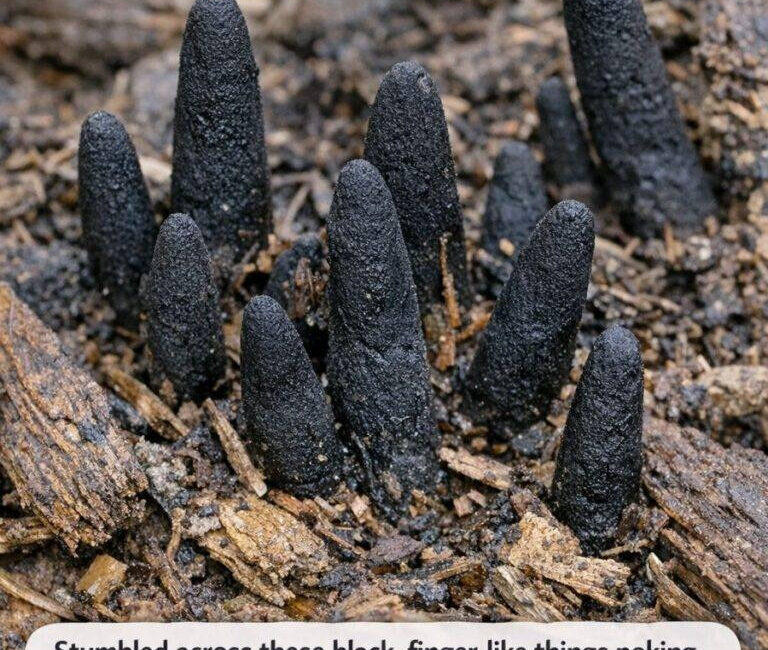
But if it’s hard, woody, black, and finger-like in mulch:
Dead Man’s Fingers is most likely.
Part XV: Why Mulch Encourages Fungal Diversity
Mulch is not sterile.
It is an ecosystem.
When you add mulch, you introduce:
- Fungal spores
- Bacterial communities
- Microarthropods
- Invertebrates
It becomes a living system.
And fungal fruiting bodies are visible proof of that life.
Your garden bed is not just decorative.
It’s biologically active.
Part XVI: Should You Be Concerned About Tree Health?
In rare cases, if Dead Man’s Fingers grows directly from a living tree trunk, it may indicate internal decay.
But this is uncommon.
If growth emerges:
- From mulch
- From buried wood
- From old stump remnants
It’s usually harmless.
If you’re concerned about tree health, inspect for:
- Soft wood
- Cracking bark
- Fungal growth on trunk
- Leaning structure
Otherwise, no cause for alarm.
Part XVII: Why It Appeared “Suddenly”
Fungi grow quickly under the right conditions.
Mycelium may exist underground for months or years before fruiting.
Then after rain and temperature shifts:
They emerge within days.
It feels sudden.
But the organism was already there.
Just hidden.
Part XVIII: Can You Eat It?
No.
It is not considered edible.
While not known as deadly toxic, it’s:
- Tough
- Woody
- Unpalatable
- Not culinary
Never consume unidentified fungi.
But touching or observing is safe.
Part XIX: The Hidden Beauty of Fungi
Once you look beyond fear, you start noticing:
- Texture complexity
- Structural adaptation
- Evolutionary design
- Ecological role
Fungi are neither plant nor animal.
They are their own kingdom.
Ancient.
Essential.
Underappreciated.
Dead Man’s Fingers is just one example of fungal architecture.
Part XX: The Bigger Lesson
Your backyard isn’t static.
It’s dynamic.
What you saw isn’t invasion.
It’s participation.
Decay feeds growth.
Growth feeds life.
Life feeds decay.
That cycle is not creepy.
It’s fundamental.
Next time you see black finger-like structures poking from mulch, instead of thinking:
“What is this horror?”
Try:
“What process is happening here?”
Because what looks eerie is often evidence of ecological health.
And once you understand it, the fingers reaching from the soil stop looking like something crawling out —
And start looking like something doing its job.