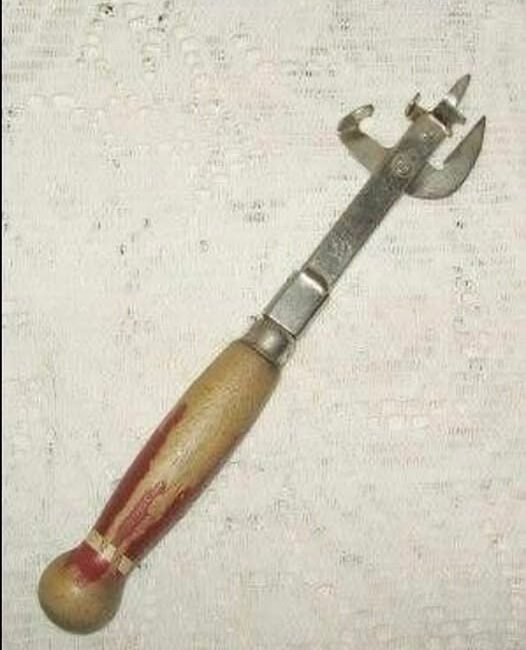
One of the most fascinating aspects of this story is that canned food existed long before can openers were invented.
In the early 19th century, inventors developed methods of preserving food in sealed metal containers. This innovation revolutionized food storage, allowing supplies to last far longer than traditional methods permitted.
Canned food quickly became valuable for soldiers, sailors, and explorers who needed durable food supplies during long journeys.
However, these early cans were extremely thick and sturdy. Opening them was not easy.
Instructions printed on some cans reportedly advised people to use hammers and chisels to access the contents.
Imagine preparing dinner with a hammer just to open a can of vegetables.
Clearly, a better solution was needed.
The First Can Opener: Ezra Warner’s Invention
The first true can opener appeared in 1858, invented by an American named Ezra Warner.
Warner’s device featured a sharp blade designed to pierce the can lid and a guard that helped control the cutting process.
Although effective, Warner’s invention was not particularly user-friendly. It required careful handling and was mainly used by the military rather than ordinary households.
Soldiers relied on the tool to access canned rations during campaigns.
For domestic kitchens, however, the device remained somewhat cumbersome.
It would take another invention to make can opening more practical for everyday cooking.
The Breakthrough of the Rotating Can Opener
In 1870, inventor William Lyman introduced a revolutionary improvement: the rotating cutting wheel.
Instead of puncturing the lid repeatedly, Lyman’s design allowed the blade to move smoothly around the edge of the can while turning a crank.
This innovation dramatically simplified the process.
The rotating can opener eventually evolved into the familiar manual design still used today in kitchens around the world.
Over time, manufacturers refined the tool further by improving the grip, sharpening the cutting wheels, and adding safety mechanisms.
The Evolution of the Can Opener Through the Decades
The history of the can opener illustrates how everyday tools evolve through human ingenuity.
During the late 19th and early 20th centuries, several variations appeared.
Lever-style openers remained common for many years, especially in military and industrial contexts.
Later designs introduced rotating wheels that allowed smoother cutting.
In the early 20th century, certain cans were manufactured with built-in keys that allowed users to roll back the lid without separate tools.
By the 1930s, the first electric can openers appeared, reflecting the growing popularity of kitchen appliances.
The 1950s introduced ergonomic manual openers designed for comfort and safety.
Today’s models often include smooth-edge technology that removes the lid without leaving sharp metal edges.
Each improvement reflects changing expectations about convenience and safety in the kitchen.
Why Vintage Tools Still Fascinate Us
Even though modern kitchens contain advanced appliances, vintage tools like the early can opener continue to capture people’s imagination.
Part of this fascination comes from nostalgia. Many people remember seeing similar tools in their grandparents’ kitchens.
These objects evoke memories of home-cooked meals, old cupboards filled with preserved foods, and family traditions passed down through generations.
Another reason is durability. Many vintage tools were built from heavy metal and designed to last for decades.
Unlike some modern products designed for short-term use, these tools reflect an era when craftsmanship emphasized longevity.
Collectors and enthusiasts often admire the raw industrial design of these objects.
Their simplicity and strength represent a different philosophy of manufacturing.
When Everyday Objects Become Collectible Artifacts
Today, vintage kitchen tools have become collectible items for those who appreciate historical craftsmanship.
Old can openers, cast iron cookware, and manual kitchen gadgets are often displayed as decorative pieces in retro-themed kitchens.
Some collectors enjoy restoring these tools to working condition, demonstrating that many still function perfectly despite their age.
For others, the value lies in their historical significance.
These objects remind us that innovation often happens gradually through small improvements to everyday tools.
A Lesson Hidden in a Simple Object
The viral mystery of the vintage can opener teaches us something profound about human curiosity.
Even the simplest objects can spark global discussions when their purpose becomes unclear.
Technology moves forward so quickly that tools once considered essential can become puzzling artifacts within a generation or two.
Yet these objects remain important pieces of our shared history.
They tell stories about how people lived, cooked, and solved practical problems long before modern conveniences appeared.
So the next time you discover a strange metal object at the bottom of an old drawer, take a closer look.
It might not just be a forgotten tool.
It might be a small piece of history waiting to be rediscovered.