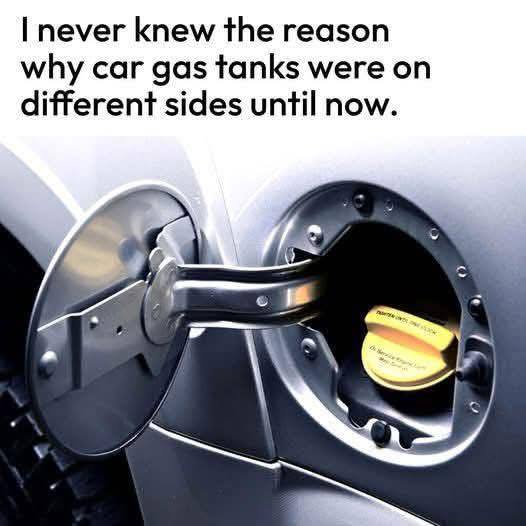
Introduction: A Small Detail That Reveals a Big Story
Most drivers have experienced that brief moment of hesitation at the gas station: you pull up to the pump, glance at your car, and suddenly realize you’re not sure which side the fuel door is on. You might lean out the window, try to remember, or even pull forward awkwardly to reposition the car. It’s a common, almost universal experience.
But have you ever stopped to ask a deeper question?
Why are gas tanks on different sides of cars in the first place?
At first glance, it feels random. Some cars have the fuel door on the left, others on the right. There is no obvious global standard. And yet, behind this seemingly simple detail lies a complex combination of engineering decisions, safety considerations, design constraints, manufacturing efficiency, and even cultural differences.
This article will take you deep into that hidden logic. Not just the “what,” but the “why.” And as you’ll see, this small detail is actually a powerful example of how systems are designed in the real world—where decisions are rarely simple, and trade-offs are always involved.
The Basic Truth: There Is No Universal Rule
Let’s start with the most important fact:
There is no global rule that says gas tanks must be on one specific side.
Car manufacturers are free to choose the placement based on what works best for each vehicle.
This might sound surprising. You might expect something as common as fuel placement to be standardized. But in reality, car design is influenced by many factors, and fuel door placement is just one small piece of a much larger puzzle.
Engineering First: The Role of Internal Layout
To understand why fuel doors differ, you need to understand how a car is built.
A Concept to Learn: Packaging in Engineering
Engineers use the term “packaging” to describe how all components fit inside a limited space.
A car is not empty inside. It contains:
- The engine
- The exhaust system
- The fuel tank
- Suspension components
- Electrical systems
- Safety structures
Everything must fit together efficiently.
Why This Affects Fuel Door Placement
The fuel tank itself is usually located:
- Near the rear of the car
- Under or behind the back seats
But the path from the fuel door to the tank matters.
Engineers must consider:
- Space for the fuel pipe
- Avoiding heat sources (like the exhaust)
- Structural integrity
If one side of the car has more available space or fewer obstacles, it becomes the logical choice.
So sometimes:
- The left side is easier
- Sometimes the right side is better
This is not random—it’s a result of internal constraints.
Safety Considerations: Protecting You Without You Realizing It
Safety plays a major role in vehicle design, including fuel systems.
Avoiding Impact Zones
In accidents, certain areas of the car are more likely to absorb impact.
Engineers try to:
- Protect the fuel tank
- Minimize risk of leaks or fire
A Concept to Learn: Crash Energy Management
Cars are designed to absorb and redirect energy during a crash.
Fuel system placement is part of this strategy.
How This Affects Fuel Door Location
Depending on the design:
- One side may offer better protection
- Structural reinforcements may differ
So the fuel door may be placed on the side that:
- Keeps the fuel system safer
- Reduces risk in collisions
Manufacturing Efficiency: The Invisible Factor
Car companies build thousands—or millions—of vehicles.
A Concept to Learn: Production Optimization
Manufacturers aim to:
- Reduce cost
- Simplify assembly
- Standardize components
If placing the fuel door on a specific side:
- Simplifies production
- Aligns with other models
They may choose that side for efficiency.
Platform Sharing
Many cars share the same base structure (called a platform).
If one model has:
- Fuel door on the right
Other models using the same platform may follow the same design.
Cultural and Regional Influences
Here’s something many people don’t realize:
Driving habits and infrastructure differ by country.
Countries That Drive on the Right Side of the Road
Examples:
- United States
- Most of Europe
- Morocco
Countries That Drive on the Left Side
Examples:
- United Kingdom
- Japan
How This Influences Design
In some cases:
- Fuel doors are placed on the side opposite traffic
Why?
Because it can be safer:
- You stand away from passing cars
- You avoid traffic exposure
However, this is not always consistent.
Gas Station Design: The Practical Reality
Modern gas stations are designed to handle both configurations.
Flexible Pump Hoses
Most stations now have:
- Long hoses
- Multi-direction access
This reduces the importance of standardization.
A Concept to Learn: System Adaptation
Instead of forcing all cars to follow one rule, the system adapts.
Gas stations are built to accommodate:
- Left-side tanks
- Right-side tanks
This flexibility removes the need for a universal standard.
The Driver’s Experience: Why It Feels Confusing
Click page 2 to continue