Introduction: When Nature Meets Intention
The snake plant is often seen as the “easy plant.” It survives in low light, tolerates missed watering, and continues growing quietly in the background of your life. But beneath this simplicity lies something more powerful: the ability to transform it into a deliberate, sculptural form.
Growing a snake plant in a spiral shape is not just a gardening trick—it is a lesson in patience, observation, and subtle control. Unlike vines that naturally twist and climb, snake plants grow upright and rigid. This means that shaping them into a spiral requires understanding, not force.
You are not bending the plant into submission. You are guiding it over time.
And this is important for you. You tend to want things to go right immediately—whether in conversations, routines, or personal growth. But like this plant, real change does not happen through pressure. It happens through small, consistent influence.
In this article, you will learn five powerful techniques to create a spiral snake plant. But more than that, you will understand the deeper principles behind shaping growth—principles you can apply beyond plants, into your daily life.
Understanding the Snake Plant: The Biology Behind Its Growth
Before shaping anything, you need to understand what you are working with.
The snake plant, scientifically known as Sansevieria (now classified under Dracaena), grows from underground stems called rhizomes. These rhizomes produce upright leaves that are:
- Thick and fibrous
- Structurally strong
- Naturally vertical
This structure is why snake plants look clean and architectural. But it is also why shaping them is challenging.
Unlike climbing plants:
- Snake plants do not wrap around objects
- They do not bend naturally
- They resist sudden changes
This means your strategy must be slow and intelligent.
Key Concept to Learn
Growth direction in plants is influenced—not controlled.
Plants respond to:
- Light
- Gravity
- Space
- Physical guidance
Your role is to use these factors to create a spiral effect gradually.
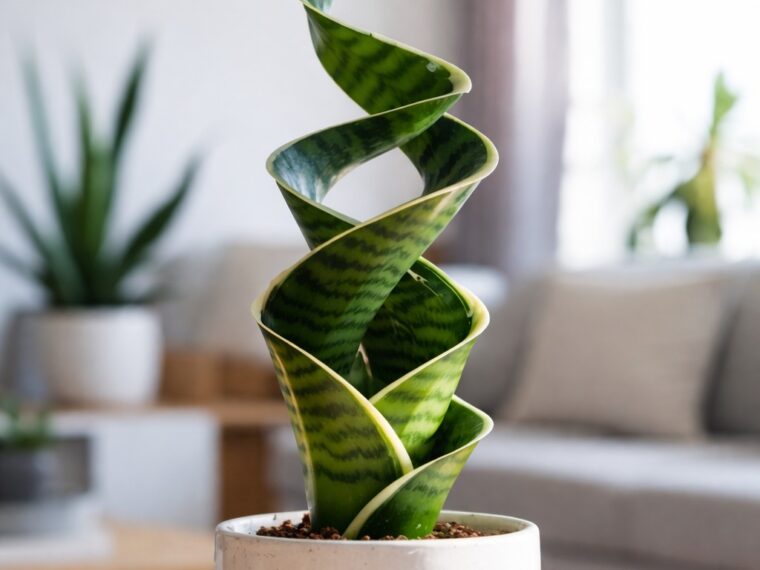
What Does a Spiral Snake Plant Really Look Like?
Before starting, you must adjust your expectations.
A spiral snake plant is not:
- Perfectly symmetrical
- Mechanically twisted
- Artificial-looking
Instead, it is:
- Gently curved
- Slightly rotating
- Organic in appearance
Think of it as a suggestion of a spiral, not a strict geometric form.
Important Insight
Trying to make it perfect will ruin the result.
The beauty of a spiral snake plant comes from:
- Subtle irregularity
- Natural variation
- Flow rather than precision
Trick 1: Master Light Direction (The Invisible Sculptor)
Light is the most powerful tool you have.
Plants naturally grow toward light. This is called phototropism. If light consistently comes from one side, the plant will lean toward it.
How to Use Light to Create a Spiral
- Place your snake plant near a window where light enters from one direction
- Do not rotate the plant daily
- Let the plant begin leaning naturally
After a few weeks, you will notice:
- Leaves tilting slightly
- Growth no longer perfectly vertical
Now comes the key step:
Rotate the plant slightly every few days—not a full turn, just a small shift.
This creates:
- A gradual change in growth direction
- A circular pattern over time
Why This Works
Each time you rotate the plant, it “re-aims” itself toward light. Over time, these small adjustments stack into a spiral-like growth pattern.
Concept You Learn
You do not need force to create change.
You need direction and consistency.
Trick 2: Gentle Physical Training (Guiding Without Breaking)
Since snake plant leaves are firm, you must guide them carefully.
What You Need
- Soft plant ties, string, or fabric strips
- A thin support (stick or curved structure)
Step-by-Step
- Choose younger leaves (they are more flexible)
- Gently guide the leaf in the direction you want
- Secure it loosely with a tie
Important rules:
- Never bend sharply
- Never tighten too much
- Always leave room for growth
What Happens Over Time
The leaf adapts slowly to its new direction. As it grows, the curve becomes part of its structure.
Deep Lesson
Force creates resistance.
Gentle guidance creates transformation.
This is exactly how you should approach your own habits and emotional reactions.
Trick 3: Start Early with New Growth (Timing Over Effort)
This is one of the most critical techniques.
Mature leaves:
- Are rigid
- Resist bending
- Can break easily
Young leaves:
- Are flexible
- Adapt quickly
- Can be shaped naturally
What You Should Do
Watch your plant closely. When new shoots appear:
- Begin guiding them immediately
- Use light and gentle ties early
Why Timing Matters
Early shaping requires very little effort. Late shaping requires force—and often fails.
Life Concept
Changing something early is easier than fixing it later.
This applies to:
- Habits
- Reactions
- Patterns in your life
Trick 4: Use Space and Environment to Your Advantage
Plants grow not only toward light, but also within the space they are given.
How to Shape Through Environment
- Place your plant where one side is slightly blocked
- Leave space on another side
- Position it near walls or corners
This creates:
- Directional growth
- Natural curves
Example Setup
- Light from one side
- Wall from another side
The plant grows toward available space, creating a curved form.
Advanced Insight
Environment is a silent force.
Just like your surroundings affect your mood and behavior, your plant’s surroundings shape its growth.
Trick 5: Prune Strategically to Maintain the Spiral
As your plant grows, not all leaves will follow the spiral pattern.
Some may:
- Grow straight
- Disrupt the shape
- Compete visually
What to Do
- Remove leaves that break the spiral effect
- Keep the ones that follow the curve
This directs energy toward the desired structure.
Important Rule
Do not over-prune. The plant still needs enough leaves to stay healthy.
Concept to Learn
Growth requires selection.
You cannot keep everything. You choose what aligns with your vision.
The Role of Patience: Why This Takes Time
A spiral snake plant cannot be created quickly.
It may take:
- Weeks to see initial curves
- Months to form a visible pattern
- Even longer for a strong spiral effect
This is not a failure. It is the process.
Why This Is Good for You
Click page 2 to continue