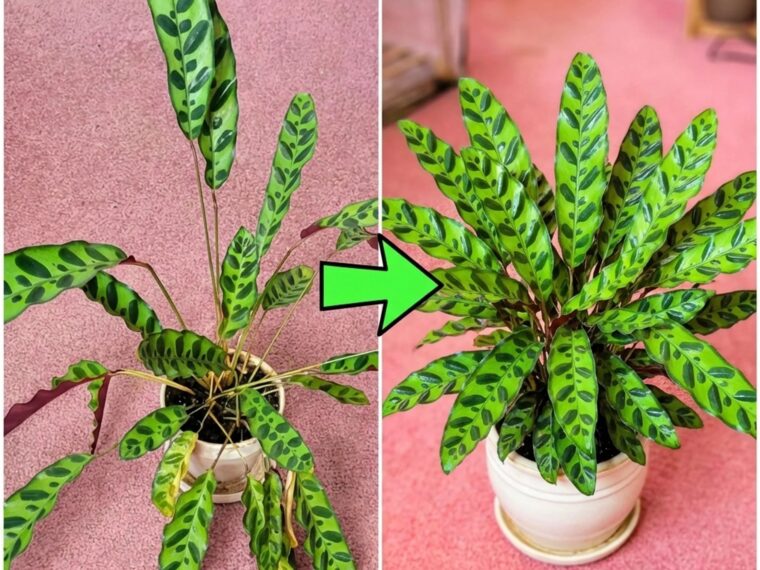
Indoor plants are more than decoration—they are living companions that reflect how well we understand nature, patience, and consistency. Among the most visually striking houseplants is the Rattlesnake Plant, a tropical beauty admired for its long, wavy leaves decorated with dark green patterns and deep purple undersides.
At first glance, this plant feels exotic, almost mysterious. Its patterns resemble reptile skin, giving it its unusual name. But beyond its appearance, the rattlesnake plant is also known for being slightly demanding. It is not difficult—but it is sensitive.
And this is where the real lesson begins.
Caring for this plant is not just about watering or sunlight. It is about understanding balance, consistency, and observation. If you learn to care for this plant properly, you are not just growing leaves—you are developing awareness, patience, and discipline.
Inspired by practical care tips , this article will take you far deeper. You will learn not only what to do, but also why it works, how to read your plant, and how this process can reflect your own personal growth.
Understanding the Nature of the Rattlesnake Plant
Before caring for any plant, you must understand where it comes from.
The rattlesnake plant originates from tropical rainforests, particularly in Brazil. In its natural environment:
- It grows under tall trees
- It receives filtered, indirect sunlight
- The air is warm and humid
- The soil is rich but well-draining
🧠 Concept to Learn: Environment Matching
Plants thrive when their indoor conditions mimic their natural habitat.
This means:
👉 You are not “forcing” the plant to adapt to you
👉 You are adapting your space to the plant
This mindset shift is powerful—not just for plants, but for life. Growth happens when conditions are right.
Light: Why Bright Indirect Light Is Essential
Light is one of the most misunderstood aspects of plant care.
The rattlesnake plant does not like direct sunlight. In nature, sunlight is filtered through layers of trees. When exposed to harsh sun indoors:
- Leaves can burn
- Patterns fade
- Edges become crispy
Ideal placement:
- Near an east-facing window
- Near a north-facing window
- A few feet away from strong sunlight
🧠 Concept to Learn: Indirect Light
Indirect light means the plant receives brightness without direct sun rays hitting the leaves.
Signs of incorrect lighting:
- Too much light → faded colors, brown edges
- Too little light → dull patterns, slow growth
Life lesson hidden here
Just like this plant, you also need the right environment to thrive. Too much pressure (like direct sun) can damage you. Too little stimulation can make you stagnant.
Balance is everything.
Watering: Finding the Perfect Balance Between Dry and Wet
Watering is where most people make mistakes.
The rattlesnake plant prefers soil that is consistently moist but never soggy.
The correct method:
- Check the top inch of soil
- If dry → water
- If still moist → wait
🧠 Concept to Learn: Root Health
Roots need both water and oxygen. When soil is too wet, roots suffocate.
Common mistakes:
- Overwatering → root rot, yellow leaves
- Underwatering → curling leaves, dry edges
Practical technique:
Water thoroughly until excess drains out, then remove the extra water.
Water Quality: Why Tap Water Can Harm Your Plant
This is something many people ignore—but it is critical.
Tap water often contains:
- Chlorine
- Fluoride
- Minerals
These can build up in the soil and cause:
- Brown leaf tips
- Weak growth
Best options:
- Distilled water
- Rainwater
- Filtered water
🧠 Concept to Learn: Sensitivity
Some plants are more sensitive than others. Calatheas are among the most sensitive.
This teaches you attention to detail—small things matter.
Humidity: The Secret to Beautiful Leaves
Humidity is one of the most important factors for this plant.
In tropical environments, humidity is naturally high. Indoors, especially with heating or air conditioning, humidity drops significantly.
Ideal humidity:
- Above 60%
Signs of low humidity:
- Brown, crispy edges
- Drooping leaves
Solutions:
- Use a humidifier
- Place a pebble tray under the plant
- Group plants together
🧠 Concept to Learn: Microclimates
A microclimate is a small area where conditions differ from the surrounding environment.
By grouping plants, you create a mini ecosystem.
Fertilizing: Feeding Without Overfeeding
Fertilizer provides nutrients that soil may lack.
Best practice:
- Feed once a month in spring and summer
- Use balanced liquid fertilizer
- Dilute to half strength
Avoid:
- Fertilizing in winter
- Overfeeding
🧠 Concept to Learn: Nutrient Balance
Too much fertilizer can burn roots and damage the plant.
More is not always better.
Pruning: Removing What No Longer Serves the Plant
Pruning is essential for healthy growth.
What to remove:
- Yellow leaves
- Brown leaves
- Damaged parts
Why it matters:
- Saves energy for new growth
- Improves appearance
- Prevents disease spread
🧠 Concept to Learn: Energy Allocation
Plants redirect energy. Removing damaged parts allows growth to focus on healthy areas.
Soil: The Foundation of Plant Health
Soil is not just dirt—it is a system that supports life.
Ideal soil mix:
- Well-draining
- Rich in organic matter
- Light and airy
Recommended components:
- Potting soil
- Perlite
- Coco peat or compost
🧠 Concept to Learn: Drainage
Drainage prevents water from sitting around roots.
Without it, root rot becomes inevitable.
Temperature: Stability Is Key
Click page 2 to continue