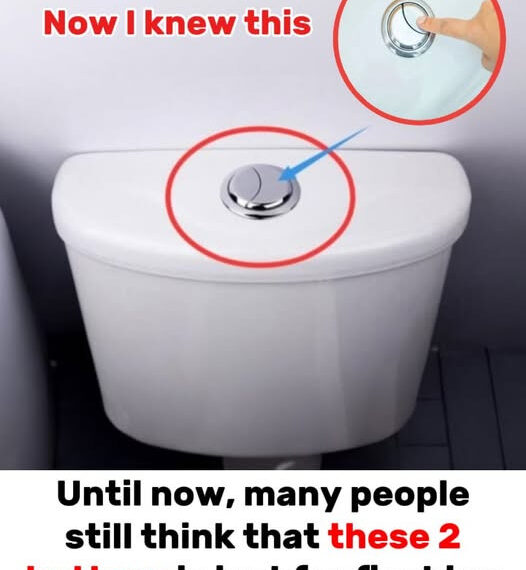
At some point in the last two decades, the bathroom quietly changed. Toilets became sleeker, tanks slimmer, buttons replaced handles, and suddenly two symbols appeared on top of something that had always been simple. For many people, those two buttons never raised a question. They were pressed automatically, instinctively, without reflection. Most people still assume they exist only to “flush,” as if one were merely an aesthetic duplicate of the other.
That assumption could not be more wrong.
Those two buttons represent one of the most carefully thought-out everyday technologies in modern homes. They are not decorative. They are not redundant. They are not optional. They are part of a system designed to change behavior, reduce waste, protect infrastructure, and quietly reshape how households interact with water — one of the most valuable resources on the planet.
The fact that so many people misunderstand them is not a failure of intelligence. It is a failure of awareness.
HOW TOILETS WENT FROM SIMPLE TO STRATEGIC
For most of human history, toilets had one job: remove waste. The design reflected that simplicity. Pull a chain, water rushes down, everything disappears. No choice, no variation, no consideration of volume.
That model worked when water was abundant, populations were smaller, and infrastructure was less strained. But as cities expanded and water treatment systems became more complex and costly, engineers began to recognize a massive inefficiency hiding in plain sight.
Not all waste is equal.
Not every flush requires the same force.
Yet traditional toilets treated every situation identically.
This meant millions of liters of clean, drinkable water were being flushed away unnecessarily every single day.
The dual-flush system was created as a response to that problem, not as a gimmick, but as a behavioral design solution.
WHY TWO BUTTONS INSTEAD OF ONE HANDLE
The choice to use two buttons instead of one was deliberate. Engineers could have used sensors, electronics, or automatic systems. Instead, they chose simplicity.
Two buttons communicate choice without instruction. One smaller, one larger. Even without text, the design suggests difference. Less. More. Light. Heavy.
This is called intuitive design. The object teaches the user how to use it — but only if the user pauses long enough to notice.
Unfortunately, many people never do.
WHAT EACH BUTTON ACTUALLY CONTROLS
The two buttons are connected to separate internal mechanisms inside the toilet tank.
The small button releases a reduced volume of water. This is known as a partial or half flush. It is designed for liquid waste and light use. It clears the bowl efficiently without unnecessary force.
The large button releases a full volume of water. This is intended for solid waste and heavier flushing needs. It provides enough pressure to clear the bowl and trap completely.
This distinction is not symbolic. It is mechanical, calibrated, and intentional.
Pressing the wrong button does not usually cause immediate problems — which is exactly why misuse goes unnoticed.
THE SCALE OF WATER WASTE CAUSED BY MISUNDERSTANDING
One incorrect flush does not feel significant. But toilets are used every day, multiple times per person.
A single full flush can use anywhere from 6 to 9 liters of water.
A partial flush may use only 3 to 4 liters.
That difference seems small until it is multiplied.
In a household of four people, using the full flush unnecessarily just five times per day can waste thousands of liters per year. Multiply that by millions of homes, and the scale becomes staggering.
This is not abstract environmental theory. It directly affects water bills, municipal infrastructure, and long-term resource availability.
And it all hinges on which button people press.
WHY PEOPLE DEFAULT TO THE WRONG BUTTON
Most misuse is driven by habit, not ignorance.
People grew up with single-flush toilets. When presented with two options, they choose the one that feels safest. The larger button feels more powerful, more reliable. There is an unconscious fear that the smaller button might not “do the job.”
This fear persists even when there is no evidence to support it.
Another factor is speed. Bathroom use is often rushed. People act automatically, not thoughtfully. The brain goes into autopilot.
Finally, there is social learning. If everyone in a household presses the same button, newcomers copy the behavior without questioning it.
Habits replicate faster than understanding.
THE HIDDEN EFFECT ON PLUMBING SYSTEMS
Using the full flush unnecessarily does more than waste water. It accelerates wear inside the toilet.
Valves open more forcefully. Seals experience greater pressure. Components degrade faster. Over time, this increases the likelihood of leaks, running toilets, and internal malfunctions.
Click page 2 to continue