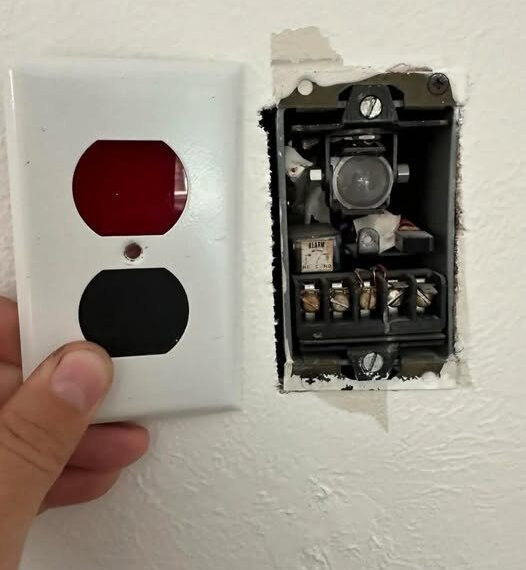
Moving into an older house is a special kind of experience. You don’t just inherit walls and floors—you inherit layers of history, decisions made decades ago, technologies that once felt cutting-edge, and systems that modern homes quietly hide or no longer use at all. Most of the time, these remnants stay out of sight. But occasionally, curiosity wins. You remove a wall plate expecting to see a normal electrical outlet… and instead you’re staring at a small metal device that looks mechanical, unfamiliar, and vaguely alarming.
That moment usually triggers a cascade of questions.
Is this safe?
Is it live?
Why does it look so old?
Who installed this?
Why are there two of them?
The good news is this: what you’ve found is almost certainly not a mistake, not a hack job, and not a hidden danger by default. It is a piece of older home infrastructure—specifically, a low-voltage transformer, most commonly used for a doorbell or chime system.
To really understand why it’s there, why it looks the way it does, and what (if anything) you should do about it, we need to go deeper than a simple answer. Because this small device is connected to how houses were designed, wired, regulated, and lived in for generations.
First: What This Device Actually Is (In Plain Terms)
The device behind that outlet-style wall plate is a step-down transformer.
Its entire job is to take standard household voltage (high voltage) and convert it into low voltage, which is safe for things like:
- Doorbells
- Door chimes
- Buzzers
- Early intercom systems
- Old alarm circuits
Doorbells, in particular, cannot run directly on household power. They require a much lower voltage—usually somewhere between 8 and 24 volts. The transformer makes that possible.
So instead of being a power outlet, this wall box is essentially a power supply for a low-voltage system elsewhere in the house.
Why It’s Inside the Wall Instead of Hidden Away
This is where modern expectations clash with older construction practices.
Today, we expect:
- Transformers hidden in basements or attics
- Clean plastic enclosures
- No exposed components behind wall plates
But older houses were built under different norms.
In many mid-20th-century homes, it was common—and code-compliant at the time—to mount doorbell transformers:
- Inside wall boxes
- Near entryways
- Close to the doorbell button or chime
- Behind blank or modified outlet covers
Electricians placed them where wiring runs were shortest and simplest. Aesthetics were secondary to function. If it worked and met code, it stayed.
What looks strange today was once considered tidy, logical, and permanent.
Why the Cover Plate Looks Like an Outlet Plate
The wall plate you removed looks like a standard outlet cover because… it is one.
Older electrical work often reused standard components for multiple purposes. Rather than manufacturing a special “transformer cover,” installers used:
- Blank plates
- Outlet plates with blocked openings
- Custom-cut plates
This kept everything flush with the wall and easy to access if needed.
To a modern homeowner, this creates confusion because we associate outlet plates with plugs and switches—not internal equipment.
Why the Device Looks Mechanical and “Industrial”
Older transformers were built very differently from modern electronics.
They were:
- Heavy
- Overbuilt
- Made with thick metal cores
- Designed to last decades
- Built before miniaturization
What you’re seeing—coils, screws, terminals—is essentially electromagnetic hardware, not digital electronics. It looks closer to machinery than to a circuit board because that’s exactly what it is.
Many of these transformers are still working 40, 50, even 70 years later.
Why There Might Be Two of Them
Finding two identical or similar devices often confuses new homeowners, but it’s extremely common in older houses.
Possible explanations include:
- One transformer for the front door, one for a back or side door
- One powering a doorbell, the other an old buzzer or chime
- One active transformer and one abandoned from a previous system
- A replacement installed without removing the original
Older homes often accumulated systems over time instead of replacing them cleanly. If something worked, it stayed—even if it was no longer used.
These are sometimes called legacy systems or ghost wiring.
Is It Dangerous to Have This in the Wall?
This is the most important question—and the answer is nuanced.
Under normal conditions, these transformers are generally safe.
They were designed to:
Click page 2 to continue