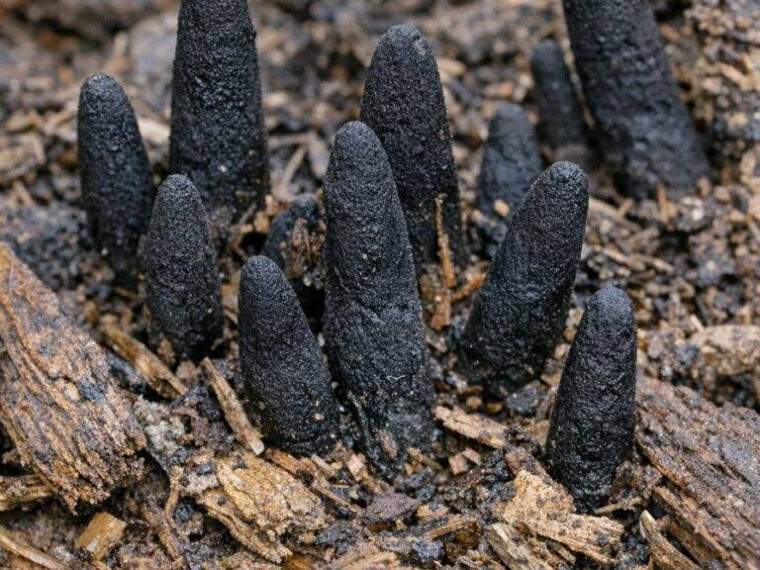
A Deep Dive Into “Dead Man’s Fingers,” Backyard Fungi, and the Secret Life of Decay
You’re walking through your backyard. Everything looks normal — mulch neatly spread, garden beds calm, maybe a little damp from last night’s watering.
Then you see them.
Black.
Finger-like.
Rigid.
Poking out of the ground like something trying to crawl back into the world.
Your brain immediately does what human brains evolved to do:
Threat assessment.
Is it an animal?
Is it toxic?
Is it some kind of parasite?
Should I remove it immediately?
The name alone doesn’t help:
Dead Man’s Fingers.
Let’s slow this down.
Because what looks like a horror movie prop is actually a fascinating, ancient, ecologically essential organism doing quiet, invisible work beneath your feet.
And once you understand it, the fear usually turns into something else:
Curiosity.
Part I: First Reaction — Why These Growths Feel So Unsettling
Humans are wired to detect shapes that resemble body parts.
This is called pareidolia — the tendency to see faces, hands, or familiar forms in random objects.
When you see dark, finger-shaped growths emerging from soil, your subconscious reacts because:
- They resemble human fingers.
- They are blackened, like decay.
- They emerge from the ground (which we associate with burial).
- They appear suddenly after rain.
It triggers primal symbolism.
Hands = life, action, movement.
Blackened fingers = death, decay, danger.
But here’s the twist:
They are decay.
Just not the kind you’re imagining.
Part II: Meet the Fungus — Xylaria polymorpha
The scientific name for what you’re likely seeing is:
Xylaria polymorpha
Common name:
Dead Man’s Fingers
Let’s decode that.
- Xylaria comes from the Greek word xylon, meaning wood.
- Polymorpha means “many forms.”
So literally:
A wood-loving fungus that appears in different shapes.
Not supernatural.
Not dangerous.
Not a sign of something dying above ground.
It is a saprobic fungus.
And that word is important.
Part III: What “Saprobic” Actually Means
Saprobic fungi feed on dead organic material.
They do not attack living plants (in most cases).
They are decomposers.
Think of them as nature’s recycling system.
Without fungi like this:
- Forests would fill with fallen trees.
- Nutrients would stay locked in wood.
- Soil fertility would collapse.
- Plant growth would slow dramatically.
Dead Man’s Fingers breaks down:
- Lignin
- Cellulose
- Buried wood
- Old roots
- Tree stumps
- Mulch made from hardwood
It appears where wood is decaying underground.
The “fingers” you see are just the fruiting bodies — the visible reproductive structures.
The real organism is hidden.
Part IV: Why It Appears in Mulch and Garden Beds
Mulch often contains:
- Shredded bark
- Wood chips
- Tree fragments
- Partially decomposed hardwood
To a saprobic fungus, that’s a buffet.
Add moisture.
Add shade.
Add moderate temperatures.
You’ve created ideal conditions.
It’s not a sign of contamination.
It’s a sign that organic material is being broken down properly.
In other words:
Your mulch is doing what mulch does.
Part V: How to Identify It With Confidence
Let’s go deeper into morphology (shape and structure).
Early Stage
- Pale gray or whitish
- Soft texture
- Slightly rubbery
- Smooth surface
Mature Stage
- Dark brown to black
- Hard and woody
- Cracked or rough exterior
- 3–4 inches tall
- Cylindrical or club-shaped
- Often clustered
If you cut one open:
- Interior is white
- Texture dense and fibrous
They typically grow:
- At base of trees
- From buried stumps
- In hardwood mulch
- In shaded areas
They rarely grow in open grass without wood present.
That’s your biggest clue.
Part VI: The Underground Network You Don’t See
The visible “fingers” are just reproductive structures.
Beneath the surface lies the mycelium — a vast web of microscopic fungal threads.
Mycelium spreads through soil and wood, digesting organic matter slowly.
Think of it as an underground neural network.
Fungi are closer to animals than plants, evolutionarily speaking.
They breathe oxygen.
They digest externally.
They absorb nutrients.
They are ancient.
Far older than trees.
Far older than mammals.
Far older than humans.
Dead Man’s Fingers is just one tiny representative of this vast kingdom.
Part VII: Is It Dangerous?
Let’s address the real concern.
Is it harmful?
For humans:
- Not poisonous through touch.
- Not known to release dangerous toxins.
- Not aggressive.
For pets:
- Generally not toxic.
- Still best to discourage chewing.
For plants:
- Usually feeds on already dead wood.
- Rarely infects healthy living trees.
It is not parasitic in the way many fear.
It’s opportunistic — feeding where decay already exists.
Part VIII: Why It Looks So Hard and Woody
As it matures, the fruiting body develops a tough outer layer.
This protects spores.
Inside those black structures are microscopic spores that eventually disperse into the air.
Spores land on other decaying wood.
Cycle continues.
The hardness is evolutionary protection.
It prevents:
- Insect damage
- Weather damage
- Premature decomposition
It’s survival architecture.
Part IX: Seasonal Patterns
You’ll most often see them:
- Late summer
- Autumn
- After heavy rain
- In moist shaded areas
Click page 2 to continue