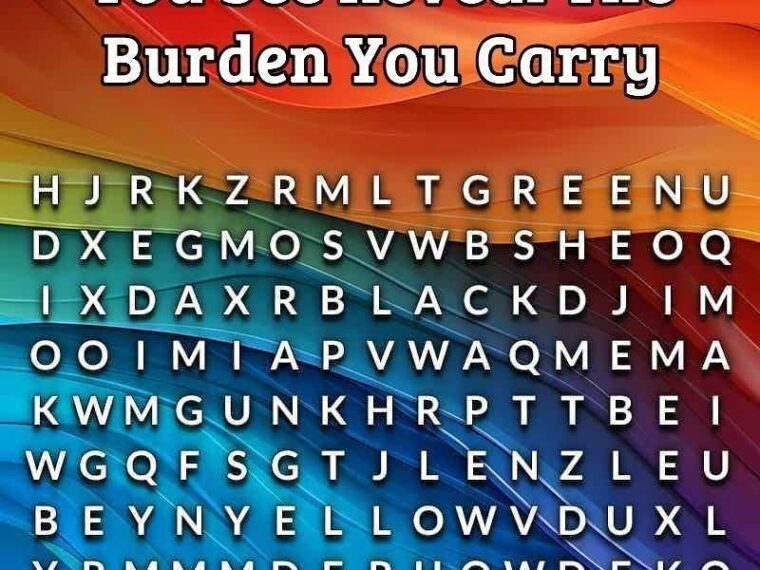
The Psychology, Neuroscience, and Emotional Language Hidden in What Your Eyes Notice First
You think you chose a color.
But what if your nervous system chose it for you?
What if the shade your eyes landed on first — red, blue, green, yellow — wasn’t random at all?
What if it was a quiet reflection of what you’re carrying right now?
Color is not decoration.
Color is signal.
It affects mood, perception, behavior, memory, appetite, attention, and even physical responses. Hospitals use calming blues and greens. Fast food chains use red and yellow to stimulate urgency and hunger. Luxury brands rely on black, deep jewel tones, and gold to communicate power and exclusivity.
But marketing is just the surface layer.
Underneath that layer lies something deeper:
Color speaks to the nervous system.
And the nervous system reveals burden.
Let’s explore why.
🧠 Part I: The Neuroscience of Color Perception
Color perception begins in the retina.
Specialized cells called cones detect different wavelengths of light:
- Short wavelengths (blue)
- Medium wavelengths (green)
- Long wavelengths (red)
These signals travel to the visual cortex.
But they don’t stop there.
Color processing also activates:
- The amygdala (emotion processing)
- The hippocampus (memory)
- The hypothalamus (stress response)
- The prefrontal cortex (interpretation and meaning)
Color is not neutral data.
It is emotionally coded information.
That’s why certain colors instantly feel calming.
Others feel aggressive.
Others feel comforting.
Your brain doesn’t just see color.
It reacts to it.
And when you notice a color first, that reaction often reflects what your nervous system is most attuned to in that moment.
🎭 Part II: Color as Emotional Projection
When multiple colors are presented simultaneously, your brain prioritizes one.
Why?
Because attention is selective.
Your mind constantly filters:
- Threat
- Reward
- Familiarity
- Emotional resonance
If you are under stress, bold colors may pull your gaze.
If you are exhausted, muted colors may feel safer.
If you feel guarded, darker shades may resonate.
This isn’t mystical.
It’s psychological salience.
Salience means:
“What stands out because it matters to me right now.”
Color becomes a mirror.
And what it reflects is often burden.
🔴 If You Saw Red First
The Burden of Pressure and Contained Fire
Red is biologically urgent.
It raises heart rate.
It increases blood pressure.
It activates alertness.
Evolutionarily, red meant:
- Blood
- Danger
- Survival
Emotionally, red represents:
- Responsibility
- Intensity
- Drive
- Suppressed anger
- High expectations
If red caught your eye first, you may be carrying pressure.
You may be the reliable one.
The strong one.
The one others lean on.
Red personalities often:
- Push through exhaustion
- Avoid showing vulnerability
- Internalize frustration
- Feel responsible for outcomes
Red is strength.
But constant strength becomes heat.
And heat without release becomes tension.
Ask yourself:
- Do I rest without guilt?
- Do I feel like I must always perform?
- Do I allow anger to surface safely?
Red doesn’t just mean passion.
It can mean too much weight.
🔵 If You Saw Blue First
The Burden of Quiet Emotional Depth
Blue is associated with calmness.
But deep blue also represents:
- Sadness
- Loneliness
- Reflection
- Emotional containment
Blue lowers heart rate.
It slows breathing.
It feels stable.
If blue stood out to you, you may carry emotional heaviness quietly.
You may:
- Process feelings internally
- Avoid burdening others
- Maintain composure in chaos
- Appear stable while feeling unseen
Blue burdens are subtle.
They don’t explode.
They sink.
Ask yourself:
- When did I last express what I truly feel?
- Do I minimize my own pain?
- Do people assume I’m “fine” because I appear calm?
Blue contains oceans beneath its surface.
🟢 If You Saw Green First
The Burden of Growth Pressure and Comparison
Green symbolizes growth and renewal.
But psychologically, it also links to:
- Envy
- Comparison
- Progress anxiety
- Stability concerns
Green sits between warm and cool tones.
It represents balance.
If green caught your eye, you may be in transition.
You may feel:
- Behind others
- Pressured to improve
- Financially uncertain
- Stuck between ambition and doubt
Green burdens often sound like:
- “I should be further.”
- “Everyone else seems ahead.”
- “Why am I not progressing fast enough?”
Growth energy is powerful.
But constant self-measurement is exhausting.
Green reminds us:
Growth takes time.
Comparison steals peace.
🟡 If You Saw Yellow First
The Burden of Mental Overload
Yellow is stimulating.
Click page 2 to continue