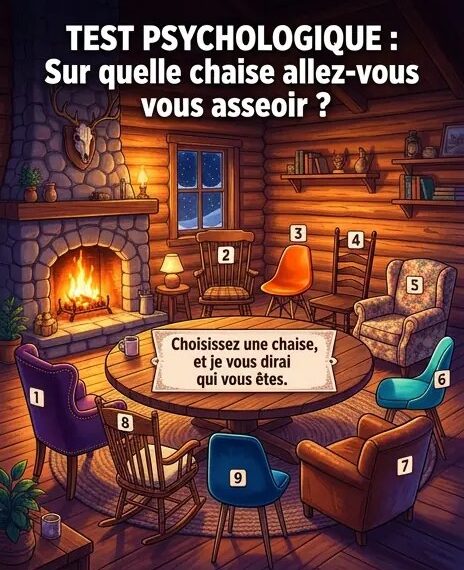
Introduction: A Simple Choice That Isn’t So Simple
Imagine this scene carefully.
You walk into a quiet, warmly lit room. At the center stands a large table. Around it, nine empty chairs. Only one person is already seated. No one tells you where to sit. No rules. No instructions. Just a simple decision.
And yet, without hesitation, you choose a place.
You don’t overthink it. You don’t analyze. You simply sit.
This moment may feel trivial—almost invisible in your day. But in reality, it is one of the most revealing psychological behaviors you perform. The seat you choose is not random. It is guided by unconscious processes shaped by your personality, emotional state, social conditioning, and even your past experiences.
This article explores, in depth, how this small decision reflects profound truths about who you are: your level of confidence, your relationship with others, your comfort with intimacy, your need for control, and even your hidden fears.
You will not only understand what your choice says about you—but you will also learn how to use this awareness to improve your relationships, your communication skills, and your self-confidence.
The Psychology of Automatic Decisions: Why Your Brain Chooses Before You Think
Before we analyze each seat, you need to understand something essential:
Your brain makes decisions before you are consciously aware of them.
This is called automatic processing.
In social situations, especially unfamiliar ones, your brain quickly scans the environment and asks:
- Is this safe?
- Where am I most comfortable?
- How close should I be to others?
- Do I want interaction or distance?
Within seconds, your brain calculates the answer—and your body follows.
This is why your seat choice feels natural. It aligns with your internal “map” of the world.
Key Concept: Comfort Zones and Social Distance
Humans naturally regulate distance in social situations. This is known in psychology as proxemics—the study of personal space.
There are four main zones:
- Intimate distance (very close, reserved for close relationships)
- Personal distance (comfortable for conversations with friends)
- Social distance (for acquaintances or strangers)
- Public distance (for observation without interaction)
Your seat choice directly reflects which zone you prefer in that moment.
Why Seat Choice Is Never Random: The Hidden Factors at Play
Many people believe they “just sit wherever.” But that’s not true.
Several invisible factors influence your decision:
1. Personality Traits
Extroverts tend to sit closer. Introverts prefer distance.
2. Emotional State
If you are tired, anxious, or overwhelmed, you will likely choose distance.
3. Confidence Level
Higher confidence often leads to more direct or central positions.
4. Social Intentions
Do you want to talk? Observe? Avoid?
5. Past Experiences
Previous positive or negative interactions shape your choices.
Your brain integrates all these elements instantly—without conscious effort.
Sitting Very Close: The Social Connector Personality
When you choose a seat directly next to the person—either the first or second chair—you are making a powerful statement, even if you don’t realize it.
What This Reveals About You
You are likely:
- Socially open
- Comfortable with interaction
- Emotionally expressive
- Quick to build connections
You don’t fear proximity. In fact, you welcome it.
Your Strengths
- You create warmth in conversations
- People feel at ease around you
- You reduce social barriers quickly
- You bring energy into the room
You are often the person who says the first word, breaks the silence, and makes situations feel alive.
The Deeper Meaning
Choosing proximity reflects low social anxiety and high relational confidence.
It means you trust others—or at least give them the benefit of the doubt.
Possible Challenges
However, this position also has a shadow side:
- You may overshare too quickly
- You might struggle with boundaries
- You may rely too much on social validation
Lesson to Learn
Closeness is powerful—but it must be balanced with awareness.
Not every situation requires immediate intimacy.
Sitting Close but Not Too Close: The Balanced Observer
If you choose a seat slightly further—third or fourth chair—you demonstrate something rare: balance.
What This Reveals About You
You are likely:
- Socially intelligent
- Observant
- Emotionally regulated
- Respectful of boundaries
You are not avoiding interaction—you are preparing for it.
Your Strengths
- You read the room before acting
- You adapt your behavior to the situation
- You maintain both connection and independence
People often see you as calm, thoughtful, and trustworthy.
The Deeper Meaning
This position reflects emotional intelligence and controlled engagement.
You don’t rush. You understand that timing matters.
Possible Challenges
- You may overanalyze situations
- You might hesitate before engaging
- You can miss opportunities by waiting too long
Lesson to Learn
Observation is a strength—but action is equally important.
At some point, you must step in.
Choosing a Distant Seat: The Independent Mind
When you choose the fifth or sixth seat—clearly distant but still present—you are expressing a different type of personality.
Clique sur page 2 pour suivre