Gardening often appears simple at first glance: plant seeds, water them, and watch them grow. Yet anyone who has spent time cultivating vegetables or flowers quickly discovers that the true foundation of a successful garden lies beneath the surface. Soil quality determines whether plants thrive or struggle. Healthy soil stores water, provides nutrients, and supports the complex biological life that allows roots to grow strong and productive.
For many gardeners, the biggest obstacle to building fertile soil in raised beds is cost. Filling a large raised bed with commercial compost or topsoil can become surprisingly expensive. Garden centers typically sell soil by the bag or cubic meter, and when a bed is deep or wide, the total price rises quickly. Many people abandon the idea of raised-bed gardening simply because of this initial expense.
Fortunately, nature provides a far more economical and often more effective solution. Instead of filling a raised bed entirely with purchased soil, gardeners can use a layering technique that transforms free organic materials into a rich growing medium. This approach works by mimicking the natural decomposition processes that occur in forests and woodland ecosystems.
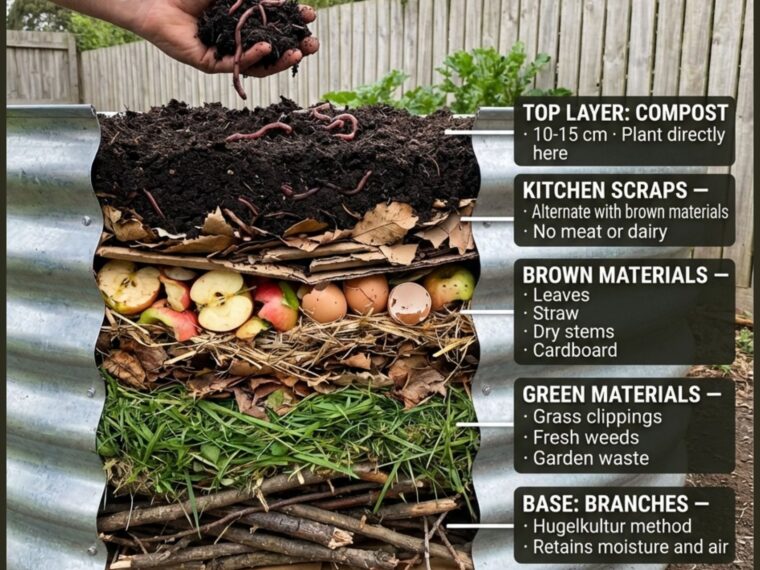
Over time, layers of organic matter break down at different speeds, releasing nutrients gradually while improving soil structure. Cardboard suppresses weeds and retains moisture. Branches create air pockets and slow-release water storage. Green plant materials supply nitrogen, while dry brown materials contribute carbon. As these components decompose together, they form humus—a stable, dark organic substance that forms the backbone of fertile soil.
This method requires patience, but it offers enormous benefits. Within a year or two, what began as kitchen scraps, garden waste, and fallen leaves transforms into a thriving ecosystem beneath your plants. The result is living soil capable of supporting abundant harvests without the heavy financial cost of purchased compost.
Understanding how this system works—and how to build it layer by layer—reveals not only a practical gardening technique but also a fascinating lesson in ecology and natural cycles.
Why Soil Is the Heart of a Garden
Before exploring the layering technique itself, it is important to understand why soil quality matters so much for plant growth. Soil is not merely dirt; it is a dynamic environment filled with organisms, minerals, water, and organic matter. Healthy soil behaves almost like a living system.
Plant roots rely on soil for three essential functions: physical support, water storage, and nutrient delivery. If soil becomes compacted or depleted of nutrients, roots struggle to absorb the resources they need. Plants may grow slowly, develop weak stems, or produce fewer fruits and vegetables.
In natural ecosystems such as forests, soil fertility is maintained through constant recycling of organic matter. Leaves fall, branches decay, and plant debris gradually breaks down under the influence of microorganisms such as bacteria and fungi. These organisms transform dead material into nutrients that future plants can use.
The layering technique used in raised beds attempts to replicate this natural process in a controlled environment. By stacking different types of organic materials, gardeners create a miniature ecosystem where decomposition occurs continuously beneath the surface.
Over time, this system produces soil that is not only fertile but also resilient and capable of sustaining plant life for many years.
The Science of Decomposition in Layered Beds
The success of the layering method depends on a fundamental biological process: decomposition. When organic materials break down, they are consumed by microorganisms that convert them into simpler chemical compounds.
This transformation releases nutrients such as nitrogen, phosphorus, and potassium—elements essential for plant growth.
However, decomposition does not occur at a uniform speed. Different materials break down at different rates depending on their composition. Soft plant tissues decompose quickly, while woody materials take much longer. Understanding this difference allows gardeners to design a raised bed that releases nutrients gradually over time.
Materials rich in nitrogen are often referred to as “green” materials. These include fresh grass clippings, kitchen vegetable scraps, and newly pulled weeds. Nitrogen fuels microbial activity, allowing bacteria and fungi to multiply rapidly.
Materials rich in carbon are known as “brown” materials. Examples include dry leaves, straw, and cardboard. Carbon provides energy for decomposing organisms and helps balance the rapid breakdown of nitrogen-rich materials.
When green and brown materials are combined in the correct proportions, they create ideal conditions for decomposition. Microorganisms begin digesting the materials, generating heat and gradually converting the mixture into compost-like soil.
This process resembles composting but occurs directly within the raised bed itself.
The Hugelkultur Principle: Using Wood as a Foundation
One of the most interesting aspects of the layering method is the use of branches and woody debris at the base of the bed. This technique draws inspiration from a traditional European gardening practice known as hugelkultur.
Hugelkultur involves burying logs, branches, and other woody materials beneath garden beds. As the wood slowly decomposes, it performs several valuable functions.
First, it creates structural stability. Branches form air pockets that prevent soil compaction and improve drainage. Good drainage is essential for plant roots because overly wet soil can lead to root rot.
Second, wood acts as a natural sponge. Over time, decaying wood absorbs water during rainfall or irrigation and gradually releases it back into the surrounding soil. This process helps maintain consistent moisture levels, reducing the need for frequent watering.
Third, decomposing wood contributes organic matter and nutrients. Although wood breaks down slowly, it eventually becomes part of the soil structure, enriching the bed over several years.
By placing branches and sticks near the bottom of the raised bed, gardeners create a long-term reservoir of moisture and nutrients that supports plant growth for seasons to come.
Layer One: The Cardboard Base
The first layer of the raised bed begins with something surprisingly simple: plain brown cardboard. This material performs several important functions that make it ideal as the foundation of the bed.
Cardboard acts as a weed barrier. When placed directly on the ground and overlapped carefully, it blocks sunlight from reaching existing weeds or grass beneath the bed. Without light, most weeds cannot continue growing and eventually die.
Unlike plastic weed barriers, cardboard gradually decomposes. Over time, soil organisms break it down, integrating it into the soil ecosystem rather than leaving behind synthetic waste.
Cardboard also retains moisture during the early stages of bed construction. When watered thoroughly, it absorbs water like a sponge and helps maintain a damp environment that encourages microbial activity.
For best results, the cardboard should be plain and free from glossy coatings. Tape, staples, and labels should be removed to prevent contamination. Overlapping the sheets ensures there are no gaps through which weeds could emerge.
Once the cardboard is laid down, it should be thoroughly soaked with water before adding the next layer.
Layer Two: Branches and Sticks
After the cardboard base comes the structural layer made from branches and sticks. This layer forms the backbone of the raised bed.
Both thick and thin branches can be used. The mixture creates a network of spaces between the wood pieces, allowing air and water to circulate through the lower portion of the bed.
Air pockets are important because plant roots require oxygen. Without adequate airflow, soil can become compacted and anaerobic, meaning oxygen levels drop and beneficial microorganisms struggle to survive.
The branches also provide long-term water management. As wood absorbs moisture, it slowly releases it back into the surrounding soil during dry periods. This natural buffering system helps maintain stable moisture levels even during hot weather.
Another benefit of using woody materials is their slow decomposition rate. Branches may take two to three years to break down completely. During that time, they gradually release nutrients while improving soil structure.
This means the raised bed continues to evolve and enrich itself long after it is built.
Layer Three: Green Materials
Once the structural base is in place, the next step is adding nitrogen-rich green materials. These materials decompose quickly and provide the energy needed for microorganisms to begin breaking down the entire system.
Common green materials include fresh grass clippings, pulled weeds, vegetable scraps, and other recently cut plant matter.
Grass clippings are particularly valuable because they contain high levels of nitrogen. However, they should be spread in thin layers rather than piled thickly. Thick layers can compact and restrict airflow, slowing decomposition.
Weeds can also be used as long as they have not yet produced seeds. Adding weeds that have already gone to seed risks introducing unwanted plants into the raised bed later.
Kitchen scraps such as vegetable peelings contribute moisture and nutrients. These materials decompose rapidly and help jump-start microbial activity within the bed.
The purpose of this layer is to activate the decomposition process. Microorganisms begin feeding on the nitrogen-rich materials, generating heat and breaking down surrounding organic matter.
Layer Four: Brown Materials
Click page 2 to continue