A Clever Vintage Kitchen Secret Revealed — And What It Says About Old-School Innovation
You’re walking through a thrift store. You see it sitting there between chipped teacups and mismatched saucers.
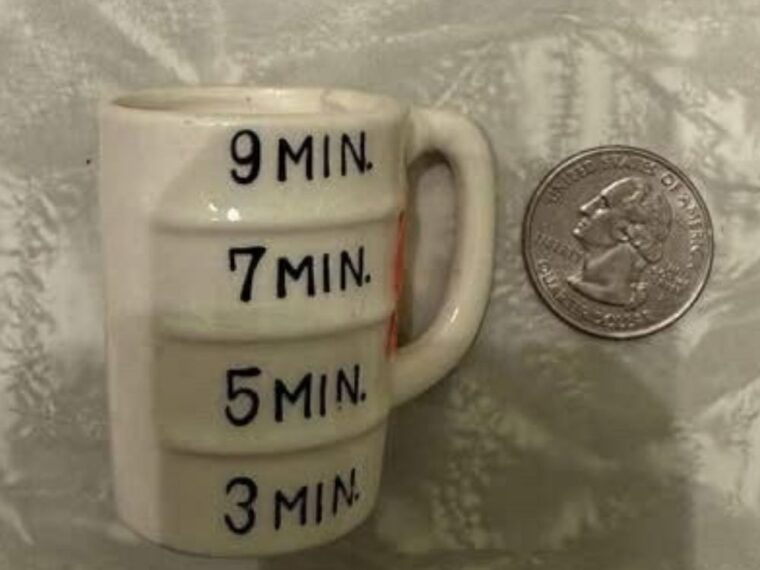
A tiny ceramic “mug.”
Small handle.
Compact size.
Numbers printed around the outside.
It looks too small for coffee. Too serious for a toy. Too specific to be decorative.
So what is it?
Here’s the twist: it’s not a mug at all.
It’s a measuring cup from a vintage Howard Electric Egg Boiler — a mid-20th-century countertop appliance that quietly solved one of the most deceptively frustrating kitchen problems in history:
How do you cook the perfect egg every single time without watching the clock?
Let’s unpack this fascinating little object — not just what it is, but what it represents about design, engineering, and the evolution of everyday kitchen intelligence.
The First Impression: Why It’s So Confusing
At first glance, the tiny ceramic piece triggers several assumptions:
- Espresso cup
- Child’s tea set accessory
- Decorative dollhouse item
- Novelty measuring cup
The numbers printed on it make it even stranger.
Minutes? Ounces? A code?
Without context, it feels like a mystery.
And that mystery is part of its charm.
The Real Identity: A Measuring Cup for Steam Timing
This tiny ceramic cup belongs to a Howard Electric Egg Boiler, a compact appliance popular in American kitchens during the 1940s–1960s.
Here’s how it worked:
Instead of placing eggs in boiling water and guessing timing manually, users would:
- Fill the ceramic cup with water up to a specific number.
- Pour that water into the egg boiler’s heating plate.
- Place the egg inside.
- Turn the device on.
Then something beautifully simple happened.
The water would heat and slowly evaporate.
When all the water had completely evaporated, the heating element would automatically shut off.
No timer required.
No guesswork.
No hovering over the stove.
The numbers on the cup weren’t minutes.
They were calibrated water levels, carefully engineered to evaporate in the precise amount of time needed for:
- Soft-boiled eggs
- Medium eggs
- Hard-boiled eggs
The appliance used physics instead of clock-watching.
That is elegant engineering.
Why This Design Was Brilliant
This device solved multiple kitchen problems at once:
1. Precision Without Technology
There were no digital displays.
No sensors.
No microchips.
Just water evaporation physics.
It turned a messy, unpredictable cooking method into a controlled process using nothing but:
- Heat
- Water volume
- Automatic shutoff
It was automation before automation.
2. Energy Efficiency
The egg boiler didn’t keep running indefinitely.
It shut off once the water was gone.
That saved electricity — long before “energy efficiency” became a marketing slogan.
3. Foolproof Simplicity
There were no complex instructions.
If you could fill a cup and pour water, you could cook the perfect egg.
This is what good design does:
It reduces human error.
The Engineering Principle Behind It
Let’s pause and admire the physics.
Water boils at 100°C (212°F) at sea level.
As long as water is present, the heating plate cannot exceed that temperature significantly because energy goes into converting liquid water into steam.
Once all the water evaporates, the temperature rises sharply.
That temperature change triggers the automatic shutoff mechanism.
So the egg boiler wasn’t timing eggs directly.
It was timing water evaporation.
The amount of water controlled cooking duration.
This is thermal physics disguised as a kitchen gadget.
Why the Ceramic Cup Was Essential
You might wonder:
Why not just use any measuring cup?
Because the ceramic cup was calibrated.
The numbers corresponded exactly to:
- The heating plate size
- The power output
- The internal steam volume
Using a random cup would ruin precision.
That’s why original ceramic cups are now the most sought-after component among collectors.
They’re easy to lose.
They look ordinary.
But they’re essential.
Without the cup, the appliance loses its brain.
A Glimpse Into Mid-Century Kitchen Culture
The Howard Egg Boiler represents a fascinating moment in domestic history.
Post-World War II America saw a surge in:
- Small electric appliances
- Time-saving devices
- Streamlined kitchen design
Households were modernizing.
Electricity was becoming universal.
Manufacturers competed to make life easier, cleaner, more efficient.
But unlike today’s tech-heavy gadgets, innovation back then relied on:
- Mechanical intelligence
- Material science
- Thermal engineering
Not software.
The egg boiler embodies this era’s optimism:
Simple problems deserved smart solutions.
Why These Appliances Are Collectible Today
Click page 2 to continue