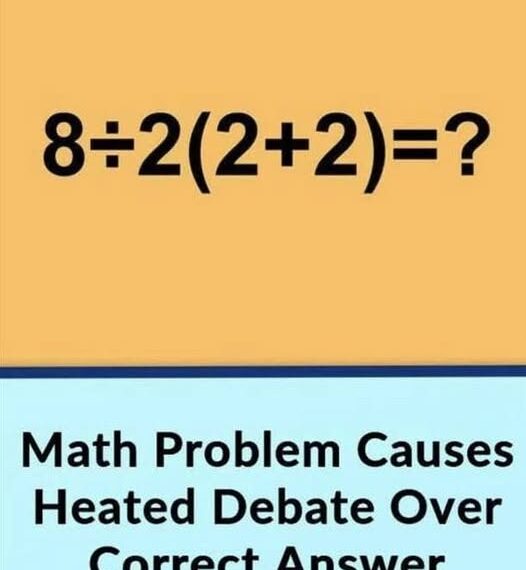
Introduction: When a Simple Equation Becomes a Global Controversy
In a world driven by rapid communication, viral content, and instant reactions, it’s easy to assume that only controversial topics—politics, culture, or social issues—can ignite heated debates.
But sometimes, something far more unexpected captures global attention:
A simple math problem.
It looks harmless. Almost trivial.
8 ÷ 2(2 + 2)
At first glance, it feels like something a child might solve in school. Yet this exact expression managed to divide thousands of people, confuse professionals, and even trigger intense discussions among scientists, engineers, and educators.
Two answers emerged:
👉 16
👉 1
Both sides defended their reasoning passionately.
But how can a mathematical expression—supposedly precise and objective—produce two different answers?
The answer lies not in mathematics itself, but in something deeper:
Interpretation, notation, and the way the human brain processes rules.
This article will take you far beyond the equation. You will understand:
- Why the problem is controversial
- How both answers can seem correct
- The limitations of mathematical notation
- What this reveals about human thinking
- Why clarity matters more than being “right”
The Equation That Started It All
Let’s begin with the expression:
8 ÷ 2(2 + 2)
At first glance, it appears straightforward. Most people instinctively apply what they learned in school: the order of operations.
But the moment you start solving, something subtle happens.
You realize that the structure is not as clear as it seems.
Understanding the Order of Operations: The Foundation of the Debate
Before solving the equation, we need to revisit a fundamental concept:
PEMDAS / BODMAS
These acronyms represent the standard order of operations:
- Parentheses / Brackets
- Exponents / Orders
- Multiplication and Division (same level)
- Addition and Subtraction (same level)
The Critical Rule
Multiplication and division are equal in priority.
This means:
👉 You solve them from left to right, not based on preference.
Solution Path 1: Why Many People Get 16
Let’s solve step by step using standard convention.
Step 1: Solve the Parentheses
2 + 2 = 4
Now the equation becomes:
8 ÷ 2 × 4
Step 2: Work Left to Right
8 ÷ 2 = 4
4 × 4 = 16
Final Answer (Method 1):
👉 16
This approach follows the widely taught interpretation of PEMDAS.
Solution Path 2: Why Some People Get 1
Now let’s examine the alternative reasoning.
Some people interpret:
2(2 + 2)
as a single grouped unit, meaning:
2 × 4 = 8
So the equation becomes:
8 ÷ 8 = 1
Final Answer (Method 2):
👉 1
The Real Issue: Ambiguity in Mathematical Notation
This is where things become interesting.
The disagreement is not about arithmetic.
It is about notation.
Implicit vs. Explicit Multiplication
There are two ways to represent multiplication:
1. Explicit Multiplication
Using a symbol:
2 × 4
2. Implicit Multiplication
Writing terms together:
2(4)
Why This Matters
In some contexts, implicit multiplication is treated as stronger or more tightly grouped.
This leads some people to interpret:
2(4) as a single unit.
The Core Problem: Lack of Clarity
Click page 2 to continue