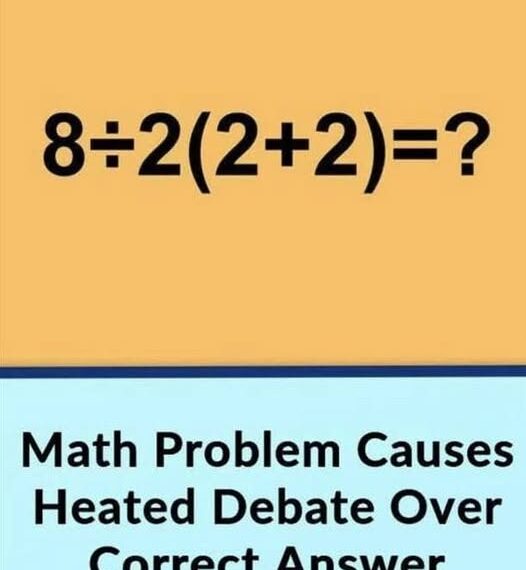
The expression:
8 ÷ 2(2 + 2)
does not clearly indicate whether:
- Division applies to everything that follows
OR - Only to the first number
This ambiguity is the root of the debate.
Mathematics vs. Notation: A Critical Distinction
Many people assume:
👉 Math is always clear and absolute.
But this is only true when the notation is precise.
Important Insight
Mathematics itself is exact.
But the way we write mathematics can be ambiguous.
The Linguistic Parallel: Why This Is Like Language
This situation is similar to language.
Consider:
- “Let’s eat, grandma.”
- “Let’s eat grandma.”
Same words. Completely different meaning.
Math notation works the same way.
Why Experts Recommend Writing It Differently
To avoid confusion, the equation could be written as:
Option 1 (for 16):
8 ÷ 2 × (2 + 2)
Option 2 (for 1):
8 ÷ [2(2 + 2)]
This removes ambiguity completely.
The Psychological Aspect: Why People Argue So Strongly
This problem didn’t just create confusion—it created conflict.
Why?
1. Identity and Intelligence
People often associate:
👉 Being correct = being intelligent
So when challenged, they defend their answer strongly.
2. Cognitive Bias
Once you believe something is correct, your brain:
- Ignores opposing logic
- Reinforces your belief
3. Simplicity vs. Complexity
Some people prefer:
- Simple, rule-based thinking
Others are comfortable with:
- Nuance and interpretation
The Deeper Lesson: Precision Matters More Than Being Right
This equation teaches something important:
👉 Being right is less important than being clear.
In real-world applications:
- Engineering
- Finance
- Programming
Ambiguity can lead to serious consequences.
Real-Life Implications: Why This Matters Beyond Math
This debate reflects real-life situations:
In Communication
Misunderstandings happen when:
- Messages are unclear
- Assumptions are made
In Work
Ambiguous instructions lead to:
- Errors
- Conflicts
- Inefficiency
In Relationships
People interpret the same situation differently.
Just like this equation.
A Broader Perspective: The Illusion of Objectivity
We often believe that:
👉 There is always one correct answer.
But sometimes:
👉 The problem itself is flawed.
This is one of those cases.
What This Problem Teaches About Thinking
1. Question the Problem Itself
Not all problems are perfectly designed.
2. Look for Ambiguity
If something seems confusing, it may be unclear—not difficult.
3. Avoid Rushing to Conclusions
Take time to analyze.
4. Accept Multiple Perspectives
Different interpretations can coexist.
The Final Truth: Which Answer Is Correct?
Technically:
👉 16 is correct under standard modern conventions
But:
👉 1 is understandable due to ambiguous notation
Conclusion: A Simple Equation with a Powerful Lesson
What started as a basic math problem turned into a global debate.
Not because math is unclear.
But because communication is.
This equation reminds us that:
- Clarity matters
- Assumptions are dangerous
- Perspective changes interpretation
And perhaps most importantly:
👉 Even in the most logical fields, human thinking plays a role.
Final Reflection
The real question was never:
“Is the answer 16 or 1?”
The real question is:
👉 “How do you interpret information when it’s not perfectly clear?”
Because that is not just a math skill.
It is a life skill.